


Video AI for corporate communications: hype or real value?

Communication that makes an impact
Video AI for corporate communications: hype or real value?
The big misconception about video AI
When people hear the term “video AI” today, they usually think of spectacular demos first: corporate videos created from just a few lines of text, AI-generated avatars, or highly realistic scenes produced entirely by artificial intelligence. Ever since the public hype around models like Sora took off, the direction has seemed clear: video creation is becoming fully automated.
It’s no surprise, then, that many companies are asking the same question right now: Will communications teams soon be creating videos simply by entering prompts?
The rise of generative AI has dramatically changed expectations. The technology feels impressive — fast, creative, and sometimes surprisingly realistic. At the same time, these developments create a sense of urgency, making companies feel they need to jump in immediately to avoid falling behind.
But in corporate communications, the reality is proving to be far more nuanced.
Communication in large organizations works differently from viral social media content or experimental AI demos. It’s not just about producing content as quickly as possible. It’s about trust, clarity, brand voice, internal alignment, and often highly sensitive information. Communications teams need control, reliability, and consistent messaging — especially when it comes to internal communications, CEO statements, or global company updates.
And that is exactly why, for many companies today, the greatest practical value of video AI does not yet lie in fully AI-generated videos.
Instead, more and more corporate communications teams are using AI to make existing video content smarter and more useful: improving discoverability, reaching international teams more effectively, and getting significantly more value out of long-form content.
In many ways, the real transformation is happening more quietly than the public hype suggests — and that is precisely what makes it so relevant for businesses.
Why corporate communications is under increasing pressure
.avif)
Corporate communications has always been a balancing act between speed, consistency, and relevance. But in recent years, the pressure on communications teams has changed significantly — and above all, intensified.
Today, companies communicate simultaneously across internal platforms, intranets, live events, social media, newsletters, employee apps, and digital town halls. At the same time, employee expectations are rising: information needs to be available faster, easier to understand, and accessible at any time.
Video, in particular, has become a core communication format.
CEO statements, town halls, change communications, training sessions, and event recordings — much of what was once shared through PDFs or emails is now delivered through video. And for good reason: video conveys emotion, creates a sense of connection, and often makes complex topics easier to understand.
But this is also where many companies are running into a new challenge.
Because producing videos is only part of the equation. The real effort often begins afterward:
- Content needs to be searchable
- International teams require translations
- Long recordings need to be structured and repurposed
- Important insights get buried in hour-long videos
- Valuable knowledge disappears into media libraries and is never used again
On top of that, many communications departments are already operating at capacity. Producing more content is often not the top priority anymore. What matters far more is finding ways to use existing content more efficiently — without adding more resources.
And this is exactly where video AI becomes interesting for corporate communications. Not as a replacement for communications teams, but as a way to organize video content more intelligently, make it more accessible, and unlock significantly more value from existing content.
What video AI often means in corporate communications today
In many companies, video AI is already being used in areas that are far less visible than AI-generated videos or avatars — but often far more relevant in the day-to-day work of communications teams.
The more videos organizations produce, the greater the challenge becomes to manage content efficiently, make it accessible, and keep it usable over the long term.
This is exactly where many AI-powered capabilities come into play.
Automatic transcription
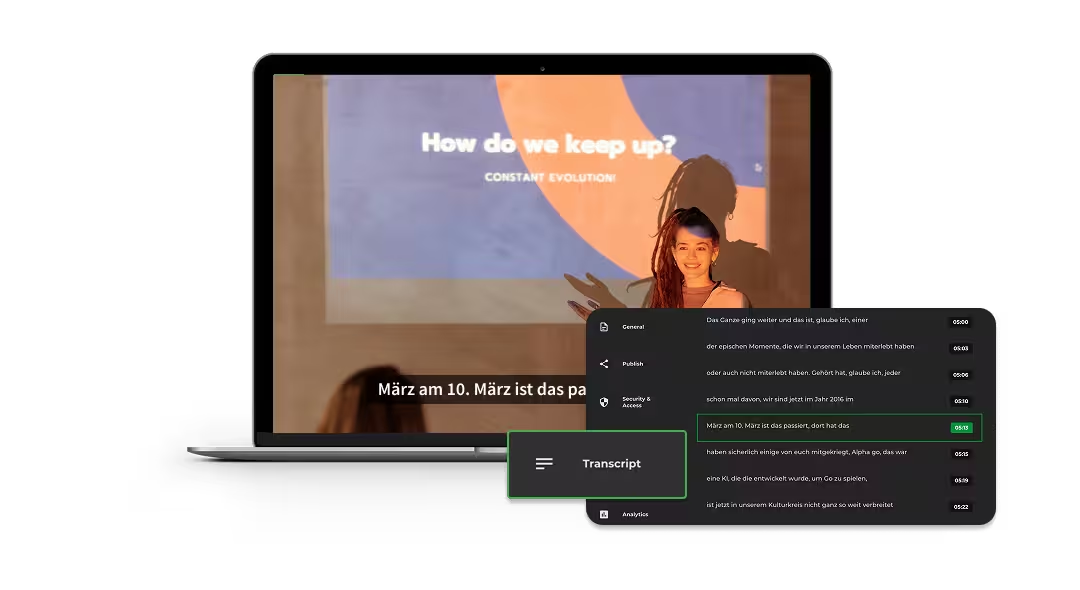
Spoken content is automatically converted into text. This not only saves time in post-production workflows, but also makes video content searchable and reusable in the first place.
Subtitles and accessibility
Subtitles improve comprehension and help make video content more accessible. They also enable more flexible viewing experiences — for example while commuting or in open office environments where audio cannot be played.
This becomes especially valuable for live formats: AI-powered subtitles can now be generated almost in real time during livestreams or digital town halls, making content significantly more accessible for broader audiences.
Translations
Global organizations face the challenge of delivering content quickly and consistently across different regions and languages. AI-powered translations can dramatically speed up this process and make global communications far more scalable.
AI-generated summaries
Not every employee has time to watch an entire town hall or a one-hour webinar. AI-generated summaries help make key information easier and faster to digest.
Chapters and navigation
Long videos become easier to navigate and more user-friendly. Viewers can jump directly to relevant topics instead of scrolling through entire recordings.
Automatically generated metadata
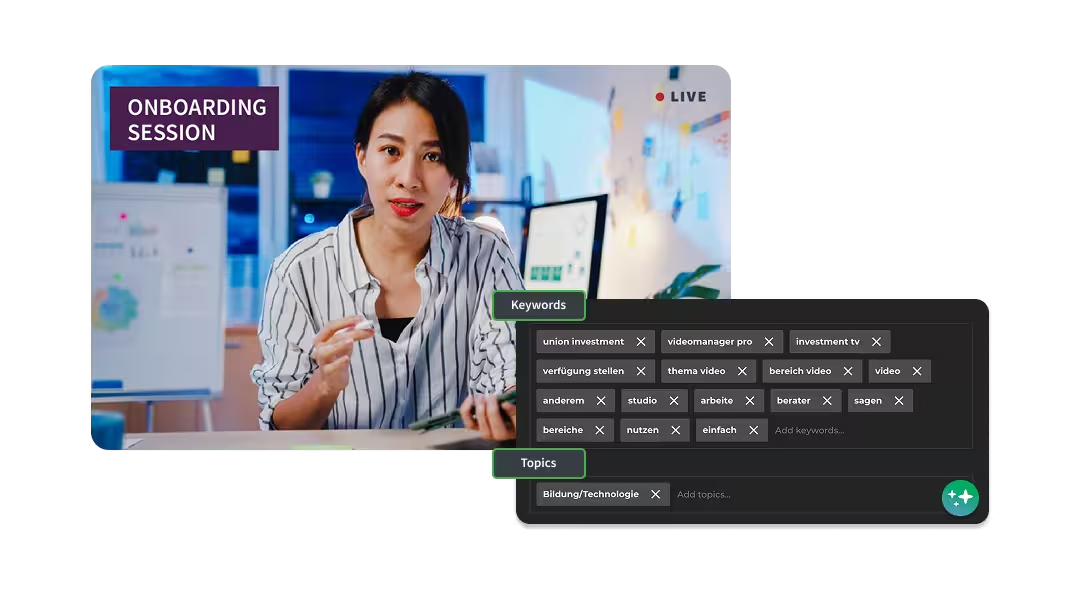
AI can automatically enrich videos with relevant metadata such as topics, speakers, content categories, or keywords. This makes large video libraries far easier to organize and helps users quickly find relevant content again.
Especially in organizations with large numbers of town halls, trainings, or event recordings, this helps keep video content discoverable and valuable long after it was first published.
Intelligent search
One of the most exciting developments is that videos are increasingly becoming searchable like documents. Employees can search for specific topics, statements, or keywords and jump directly to the exact moment in the video where they are mentioned.
Repurposing long-form video content
A single webinar or event recording can suddenly generate multiple reusable assets: short clips, highlight sequences, recaps, or social media snippets. This allows communications teams to get significantly more value from existing content.
And this is where the real difference between hype and practical value becomes clear: many of these applications may seem less spectacular at first glance than AI-generated videos or avatars. But for corporate communications teams, they often deliver far greater value in day-to-day operations.
Where video AI creates real value — and where it doesn’t
Many of the most relevant developments in video AI today are not necessarily happening in automated content creation, but in the way companies work with existing video content.
For many communications teams, the challenge is no longer producing enough content in the first place. The real difficulty lies in keeping growing volumes of video content usable and manageable across teams, locations, and channels.
This is where many practical AI applications for corporate communications are emerging today.
AI helps scale communications — not strategy
Corporate communications teams are producing more video content than ever before. At the same time, team sizes and resources often remain unchanged. This is exactly where AI can help: reducing repetitive tasks, speeding up content preparation, and making workflows more efficient.
What AI does not replace, however, is strategic communications work itself.
AI does not create credible change communications, replace leadership communication, or understand company culture. Communications teams remain responsible for tone of voice, context, and trust.
In that sense, AI becomes less of a replacement for corporate communications and more of an amplifier for the work teams are already doing.
Videos are finally becoming searchable
One of the biggest advantages of video AI today is improved knowledge discoverability.
Many companies now have enormous volumes of video content: town halls, training sessions, CEO updates, webinars, and internal events. The problem is often not a lack of content — but the fact that important information becomes nearly impossible to find later on.
Transcripts, intelligent metadata, and AI-powered search are changing that. Employees can search for topics, keywords, or specific statements and jump directly to the relevant moment within a video.
As a result, video is increasingly evolving from a pure communication format into a searchable knowledge resource.
Greater reach through accessibility and translation

Accessibility is becoming increasingly important for organizations — not just from a regulatory perspective, but also as a communication priority.
Subtitles, transcripts, and translations help make content accessible to more people. Employees can consume information more flexibly, international teams can be reached more effectively, and content works far more efficiently across language barriers.
For global organizations in particular, video AI is quickly becoming a key enabler for scaling internal communications.
Getting more value from existing content
Many companies already sit on a huge amount of valuable video content. But much of it is only used once — during a livestream or immediately after an event.
AI is changing that as well.
Long recordings can quickly be turned into highlight clips, summaries, chapters, or short snippets. Content remains relevant for longer and can be reused across multiple channels and formats.
For communications teams, this ultimately means one thing above all: greater impact from the same amount of effort.
What companies should consider when adopting video AI
As great as the potential of video AI may be, successful adoption in large organizations depends on more than just the technology itself. Equally important is how well AI can integrate into existing communication and business processes.
This is especially true in corporate communications, where the requirements differ significantly from public-facing content marketing or consumer use cases.
Data privacy and security
As soon as sensitive company information, internal town halls, or CEO communications are involved, data privacy and secure hosting structures become critical.
Organizations need a clear understanding of:
- where content is being processed
- what data is being stored
- how AI models are trained
- and who has access to the content
For global enterprises and regulated industries in particular, these factors quickly become decisive selection criteria.
Quality still requires human oversight

Even though AI can automate many processes, human review and editorial oversight remain essential.
Automatic transcripts, translations, or summaries can save enormous amounts of time — but they are not always error-free. Especially when dealing with sensitive topics, technical terminology, or strategic communications, approval workflows and quality control are still necessary.
That is why the most successful organizations are not relying on full automation, but on meaningful AI-assisted support.
AI should simplify existing workflows
New tools only create real value if they genuinely simplify workflows.
If communications teams have to move content between platforms, manually edit outputs, or manage additional processes, efficiency quickly turns into friction.
That is why integration is becoming increasingly important: AI capabilities should fit seamlessly into existing video and communications workflows.
Governance remains essential
The more video content organizations produce, the more important clear rules for access, publishing, and content management become.
Who is allowed to view content? Who can edit videos? Which content can be shared externally? And how long should content remain available?
AI does not automatically solve these questions — but it often makes strong governance even more important.
This is exactly why many companies are discovering that the greatest value does not come from the most spectacular AI applications, but from solutions that integrate securely, efficiently, and reliably into everyday communications workflows.
Conclusion: Video AI as an amplifier for corporate communications
The public hype around video AI is currently focused on generated content, avatars, and videos created at the push of a button. But in corporate communications, a far more practical reality is already emerging.
The greatest value often comes from making existing video processes smarter: helping content become easier to find, more accessible, and more useful over time. Transcripts, subtitles, translations, intelligent search, and automated summaries may seem less spectacular than AI-generated videos — but in the day-to-day work of large communications teams, they often create far greater impact.
Because companies do not simply need more content. They need better ways to manage and use growing volumes of video content efficiently.
And perhaps that is the biggest misconception about video AI: not everything that creates the biggest hype automatically delivers the greatest value.
.avif)


.avif)
FAQ:
1. What does video AI mean in corporate communications?
Video AI refers to the use of artificial intelligence to improve video content and workflows in corporate communications. This includes features such as automatic transcription, subtitles, translations, intelligent search, and AI-generated summaries.
2. Will video AI replace communications teams?
No. AI can help communications teams automate repetitive tasks and improve efficiency, but strategy, tone of voice, context, and trust still require human expertise.
3. What are the benefits of video AI for internal communications?
Video AI can make internal communications more accessible, scalable, and efficient. Employees can find information faster, videos become searchable, and global teams can be reached more effectively through subtitles and translations.
4. How does AI make video content more usable?
AI can automatically transcribe videos, generate metadata, create chapters, and summarize content. This makes videos easier to organize, search, and reuse over time.
5. What should companies consider when implementing video AI?
Organizations should pay close attention to data privacy, secure hosting, workflow integration, and governance. Most importantly, AI should simplify communication processes rather than create additional complexity.
Our Speakers
The big misconception about video AI
When people hear the term “video AI” today, they usually think of spectacular demos first: corporate videos created from just a few lines of text, AI-generated avatars, or highly realistic scenes produced entirely by artificial intelligence. Ever since the public hype around models like Sora took off, the direction has seemed clear: video creation is becoming fully automated.
It’s no surprise, then, that many companies are asking the same question right now: Will communications teams soon be creating videos simply by entering prompts?
The rise of generative AI has dramatically changed expectations. The technology feels impressive — fast, creative, and sometimes surprisingly realistic. At the same time, these developments create a sense of urgency, making companies feel they need to jump in immediately to avoid falling behind.
But in corporate communications, the reality is proving to be far more nuanced.
Communication in large organizations works differently from viral social media content or experimental AI demos. It’s not just about producing content as quickly as possible. It’s about trust, clarity, brand voice, internal alignment, and often highly sensitive information. Communications teams need control, reliability, and consistent messaging — especially when it comes to internal communications, CEO statements, or global company updates.
And that is exactly why, for many companies today, the greatest practical value of video AI does not yet lie in fully AI-generated videos.
Instead, more and more corporate communications teams are using AI to make existing video content smarter and more useful: improving discoverability, reaching international teams more effectively, and getting significantly more value out of long-form content.
In many ways, the real transformation is happening more quietly than the public hype suggests — and that is precisely what makes it so relevant for businesses.
Why corporate communications is under increasing pressure
Corporate communications has always been a balancing act between speed, consistency, and relevance. But in recent years, the pressure on communications teams has changed significantly — and above all, intensified.
Today, companies communicate simultaneously across internal platforms, intranets, live events, social media, newsletters, employee apps, and digital town halls. At the same time, employee expectations are rising: information needs to be available faster, easier to understand, and accessible at any time.
Video, in particular, has become a core communication format.
CEO statements, town halls, change communications, training sessions, and event recordings — much of what was once shared through PDFs or emails is now delivered through video. And for good reason: video conveys emotion, creates a sense of connection, and often makes complex topics easier to understand.
But this is also where many companies are running into a new challenge.
Because producing videos is only part of the equation. The real effort often begins afterward:
- Content needs to be searchable
- International teams require translations
- Long recordings need to be structured and repurposed
- Important insights get buried in hour-long videos
- Valuable knowledge disappears into media libraries and is never used again
On top of that, many communications departments are already operating at capacity. Producing more content is often not the top priority anymore. What matters far more is finding ways to use existing content more efficiently — without adding more resources.
And this is exactly where video AI becomes interesting for corporate communications. Not as a replacement for communications teams, but as a way to organize video content more intelligently, make it more accessible, and unlock significantly more value from existing content.
What video AI often means in corporate communications today
In many companies, video AI is already being used in areas that are far less visible than AI-generated videos or avatars — but often far more relevant in the day-to-day work of communications teams.
The more videos organizations produce, the greater the challenge becomes to manage content efficiently, make it accessible, and keep it usable over the long term.
This is exactly where many AI-powered capabilities come into play.
Automatic transcription
Spoken content is automatically converted into text. This not only saves time in post-production workflows, but also makes video content searchable and reusable in the first place.
Subtitles and accessibility
Subtitles improve comprehension and help make video content more accessible. They also enable more flexible viewing experiences — for example while commuting or in open office environments where audio cannot be played.
This becomes especially valuable for live formats: AI-powered subtitles can now be generated almost in real time during livestreams or digital town halls, making content significantly more accessible for broader audiences.
Translations
Global organizations face the challenge of delivering content quickly and consistently across different regions and languages. AI-powered translations can dramatically speed up this process and make global communications far more scalable.
AI-generated summaries
Not every employee has time to watch an entire town hall or a one-hour webinar. AI-generated summaries help make key information easier and faster to digest.
Chapters and navigation
Long videos become easier to navigate and more user-friendly. Viewers can jump directly to relevant topics instead of scrolling through entire recordings.
Automatically generated metadata
AI can automatically enrich videos with relevant metadata such as topics, speakers, content categories, or keywords. This makes large video libraries far easier to organize and helps users quickly find relevant content again.
Especially in organizations with large numbers of town halls, trainings, or event recordings, this helps keep video content discoverable and valuable long after it was first published.
Intelligent search
One of the most exciting developments is that videos are increasingly becoming searchable like documents. Employees can search for specific topics, statements, or keywords and jump directly to the exact moment in the video where they are mentioned.
Repurposing long-form video content
A single webinar or event recording can suddenly generate multiple reusable assets: short clips, highlight sequences, recaps, or social media snippets. This allows communications teams to get significantly more value from existing content.
And this is where the real difference between hype and practical value becomes clear: many of these applications may seem less spectacular at first glance than AI-generated videos or avatars. But for corporate communications teams, they often deliver far greater value in day-to-day operations.
Where video AI creates real value — and where it doesn’t
Many of the most relevant developments in video AI today are not necessarily happening in automated content creation, but in the way companies work with existing video content.
For many communications teams, the challenge is no longer producing enough content in the first place. The real difficulty lies in keeping growing volumes of video content usable and manageable across teams, locations, and channels.
This is where many practical AI applications for corporate communications are emerging today.
AI helps scale communications — not strategy
Corporate communications teams are producing more video content than ever before. At the same time, team sizes and resources often remain unchanged. This is exactly where AI can help: reducing repetitive tasks, speeding up content preparation, and making workflows more efficient.
What AI does not replace, however, is strategic communications work itself.
AI does not create credible change communications, replace leadership communication, or understand company culture. Communications teams remain responsible for tone of voice, context, and trust.
In that sense, AI becomes less of a replacement for corporate communications and more of an amplifier for the work teams are already doing.
Videos are finally becoming searchable
One of the biggest advantages of video AI today is improved knowledge discoverability.
Many companies now have enormous volumes of video content: town halls, training sessions, CEO updates, webinars, and internal events. The problem is often not a lack of content — but the fact that important information becomes nearly impossible to find later on.
Transcripts, intelligent metadata, and AI-powered search are changing that. Employees can search for topics, keywords, or specific statements and jump directly to the relevant moment within a video.
As a result, video is increasingly evolving from a pure communication format into a searchable knowledge resource.
Greater reach through accessibility and translation
Accessibility is becoming increasingly important for organizations — not just from a regulatory perspective, but also as a communication priority.
Subtitles, transcripts, and translations help make content accessible to more people. Employees can consume information more flexibly, international teams can be reached more effectively, and content works far more efficiently across language barriers.
For global organizations in particular, video AI is quickly becoming a key enabler for scaling internal communications.
Getting more value from existing content
Many companies already sit on a huge amount of valuable video content. But much of it is only used once — during a livestream or immediately after an event.
AI is changing that as well.
Long recordings can quickly be turned into highlight clips, summaries, chapters, or short snippets. Content remains relevant for longer and can be reused across multiple channels and formats.
For communications teams, this ultimately means one thing above all: greater impact from the same amount of effort.
What companies should consider when adopting video AI
As great as the potential of video AI may be, successful adoption in large organizations depends on more than just the technology itself. Equally important is how well AI can integrate into existing communication and business processes.
This is especially true in corporate communications, where the requirements differ significantly from public-facing content marketing or consumer use cases.
Data privacy and security
As soon as sensitive company information, internal town halls, or CEO communications are involved, data privacy and secure hosting structures become critical.
Organizations need a clear understanding of:
- where content is being processed
- what data is being stored
- how AI models are trained
- and who has access to the content
For global enterprises and regulated industries in particular, these factors quickly become decisive selection criteria.
Quality still requires human oversight
Even though AI can automate many processes, human review and editorial oversight remain essential.
Automatic transcripts, translations, or summaries can save enormous amounts of time — but they are not always error-free. Especially when dealing with sensitive topics, technical terminology, or strategic communications, approval workflows and quality control are still necessary.
That is why the most successful organizations are not relying on full automation, but on meaningful AI-assisted support.
AI should simplify existing workflows
New tools only create real value if they genuinely simplify workflows.
If communications teams have to move content between platforms, manually edit outputs, or manage additional processes, efficiency quickly turns into friction.
That is why integration is becoming increasingly important: AI capabilities should fit seamlessly into existing video and communications workflows.
Governance remains essential
The more video content organizations produce, the more important clear rules for access, publishing, and content management become.
Who is allowed to view content? Who can edit videos? Which content can be shared externally? And how long should content remain available?
AI does not automatically solve these questions — but it often makes strong governance even more important.
This is exactly why many companies are discovering that the greatest value does not come from the most spectacular AI applications, but from solutions that integrate securely, efficiently, and reliably into everyday communications workflows.
Conclusion: Video AI as an amplifier for corporate communications
The public hype around video AI is currently focused on generated content, avatars, and videos created at the push of a button. But in corporate communications, a far more practical reality is already emerging.
The greatest value often comes from making existing video processes smarter: helping content become easier to find, more accessible, and more useful over time. Transcripts, subtitles, translations, intelligent search, and automated summaries may seem less spectacular than AI-generated videos — but in the day-to-day work of large communications teams, they often create far greater impact.
Because companies do not simply need more content. They need better ways to manage and use growing volumes of video content efficiently.
And perhaps that is the biggest misconception about video AI: not everything that creates the biggest hype automatically delivers the greatest value.

FAQ:
1. What does video AI mean in corporate communications?
Video AI refers to the use of artificial intelligence to improve video content and workflows in corporate communications. This includes features such as automatic transcription, subtitles, translations, intelligent search, and AI-generated summaries.
2. Will video AI replace communications teams?
No. AI can help communications teams automate repetitive tasks and improve efficiency, but strategy, tone of voice, context, and trust still require human expertise.
3. What are the benefits of video AI for internal communications?
Video AI can make internal communications more accessible, scalable, and efficient. Employees can find information faster, videos become searchable, and global teams can be reached more effectively through subtitles and translations.
4. How does AI make video content more usable?
AI can automatically transcribe videos, generate metadata, create chapters, and summarize content. This makes videos easier to organize, search, and reuse over time.
5. What should companies consider when implementing video AI?
Organizations should pay close attention to data privacy, secure hosting, workflow integration, and governance. Most importantly, AI should simplify communication processes rather than create additional complexity.
Our Speakers
Voices from our customers





.avif)


.avif "Corporate Communications 2027: Agentic AI Webinar")