

Published on
From CEO messages to crisis comms: livestreaming use cases with real impact

Communication that makes an impact
From CEO messages to crisis comms: livestreaming use cases with real impact
Why corporate communications needs a rethink
Corporate communications is under growing pressure. Communication has to be faster, more transparent, and more dialog-driven—while expectations from employees, media, and other stakeholders continue to rise. Information spreads in real time, and so do rumors. To remain credible, companies need to be visible and accessible.
At the same time, the conditions for communication have fundamentally changed. Hybrid work models, international teams, and increasingly digital media consumption have reduced the effectiveness of traditional formats. An email may reach many people, but it rarely creates real dialogue. A press release informs, but it does not create presence.
This is where livestreaming becomes relevant—not as a technical gimmick or event add-on, but as a strategic communication tool for situations where immediacy, leadership visibility, and direct engagement matter. The key question is therefore not whether livestreaming makes sense, but in which specific use cases it delivers the greatest value for corporate communications.
What livestreaming truly delivers in corporate communications
In a corporate context, livestreaming refers to the professional real-time broadcast of video to internal or external audiences—such as employees, investors, media representatives, or partners. These formats are often enhanced with interactive elements like moderated Q&A sessions, live chats, or polls. Content can also be recorded and made available on demand afterward.
The key difference compared to pre-recorded video or purely written communication lies in simultaneity: all relevant stakeholders receive the same message at the same time. This creates transparency, reduces room for interpretation, and signals openness.
Visibility is another crucial factor. Executives, spokespersons, or communications teams appear directly on screen. Attitude, tone, and nonverbal cues become part of the message. Especially in sensitive or complex situations, this creates added value that goes beyond simply sharing information.
For corporate communications, this leads to a clear conclusion: livestreaming is particularly effective when reach, speed, and dialogue need to come together—during clearly defined communication-critical moments. The following use cases illustrate what that looks like in practice.
The most important livestreaming use cases for corporate communications
CEO messages and town halls: making leadership visible

Strategic realignments, quarterly results, reorganizations, or mergers are moments when employees and stakeholders need orientation. In such situations, a written statement is often not enough. Employees want to understand how decisions were made—and what they mean in practice.
A livestream allows executives to deliver key messages personally and demonstrate leadership and accountability. Tone, presence, and the ability to respond to questions create a sense of closeness—even in globally distributed organizations. Town hall formats with moderated Q&A sessions, in particular, strengthen the feeling of being involved rather than simply being informed.
For internal communications, this means: livestreaming supports leadership communication where trust, transparency, and dialogue are essential.
Crisis communication: fast, consistent, transparent

Crisis situations—such as cybersecurity incidents, product recalls, or reputational issues—require clear and consistent communication. Speed is critical. Delayed or fragmented information increases uncertainty and fuels speculation.
A livestream creates a controlled environment for real-time communication. Companies can provide context, explain measures being taken, and communicate transparently about next steps. At the same time, moderated questions allow key concerns to be addressed without losing control of the overall message.
It is important to note: livestreaming does not replace a crisis strategy. However, it is a powerful tool within a structured crisis management approach—especially when many internal or external stakeholders need to be reached simultaneously.
Investor relations, financial communication, and annual general meetings
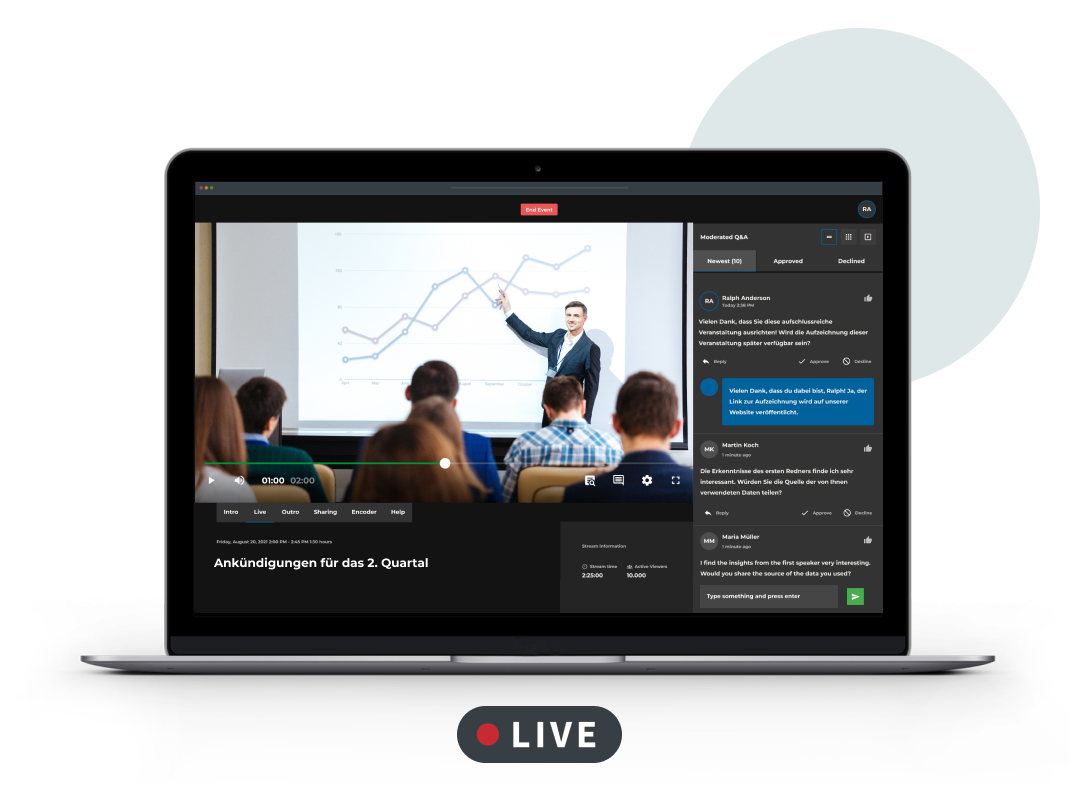
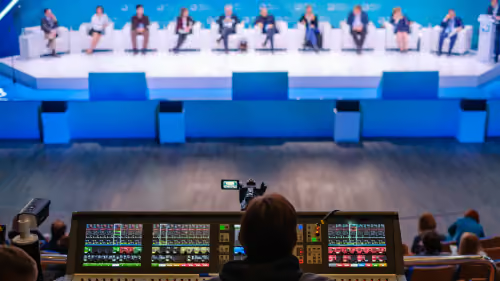
Livestreaming has also become firmly established in financial communications. Quarterly reports, earnings calls, and capital markets days can be delivered professionally and at scale, including presentations and moderated Q&A sessions.
A particularly relevant use case is the (virtual or hybrid) annual general meeting (AGM). In recent years, digital formats have become standard practice for many organizations. Livestreaming enables companies to engage shareholders regardless of location, broadcast speeches transparently, and meet formal requirements in a professional manner. At the same time, control over the agenda, moderation, and technical stability is maintained.
For investors and analysts, this provides easy access to relevant information. For companies, it creates an opportunity to demonstrate transparency and reach international audiences without geographic limitations. Especially when communicating complex financial figures or strategic outlooks, a visual and personal format adds value beyond written reports.
Change communication and transformation

Digital transformation, new business models, or cultural change initiatives affect organizations at multiple levels. Change processes often raise questions, uncertainty, or resistance.
Livestreams can serve as recurring formats to communicate progress, explain context, and create space for dialogue. Regular updates—such as a monthly live series—signal continuity and openness.
For corporate communications, this means that livestreaming can help structure and sustain change communication, particularly in hybrid organizations with distributed teams.
Press events and external corporate announcements

Product launches, strategic partnerships, or sustainability initiatives are moments when reach and visibility are crucial. Physical press conferences quickly reach logistical limits.
A livestream significantly expands that reach. Journalists, partners, and other stakeholders can participate regardless of location. Content can also be made available on demand afterward or integrated into social media channels.
For external corporate communications, this creates a scalable format that builds presence while remaining flexible and adaptable.
When livestreaming makes strategic sense—and when it doesn’t
Not every message requires a live format. In corporate communications in particular, it is essential to choose formats deliberately rather than follow trends. Livestreaming delivers the greatest value when certain conditions are met.
A livestream is strategically effective when speed plays a central role. If information is time-sensitive or a large number of stakeholders need to be addressed simultaneously, real-time communication offers clear advantages. This applies, for example, to major strategic announcements, crisis situations, or important leadership updates.
Visibility is another key factor. Whenever communication goes beyond simply sharing information—when it requires context, positioning, and orientation—the visual format becomes more powerful. Executives and spokespersons are perceived as people, not just roles. This strengthens trust, especially during periods of change or uncertainty.
Dialogue is equally important. If questions are expected or if space for exchange is intentionally created, livestreaming with moderated Q&A formats provides a structured environment for interaction—without losing control of the message.
By contrast, livestreaming is less suitable for purely administrative or highly formal content that requires little explanation. If messages are not yet finalized or sensitive details remain unclear, an asynchronous format may be more appropriate. Live communication requires preparation, clarity, and reliable processes.
For corporate communications, this means: livestreaming should be viewed as a strategic tool—not a default solution. Its value emerges where reach, relevance, and dialogue intersect.
Success factors for livestreams in corporate communications
For livestreaming to be effective in a corporate environment, clear conditions need to be in place. Technology alone is not enough—what matters most is how the format is embedded in the overall communication strategy.
First, a precise objective is essential. Is the goal to inform, motivate, provide context, or build trust? The purpose determines the structure, length, and level of interaction within the format.
Thorough content preparation is equally important. Messages need to be aligned internally, potential questions anticipated, and key arguments clearly formulated. Especially in CEO statements, annual general meetings, or crisis communication, consistent and well-coordinated messaging is critical.
Technical reliability is not a minor detail. A professional corporate livestream requires stable infrastructure, clear moderation, and well-defined processes. Only then does the format convey confidence and control—particularly in external communications.
Finally, follow-up plays a crucial role in creating long-term value. Recordings, summaries, or additional content extend reach and make the livestream accessible to those who could not attend live. At the same time, analytics and engagement data provide valuable insights for optimizing future formats.
Conclusion: livestreaming as a core element of modern corporate communications
From CEO messages and crisis communication to annual general meetings, the range of livestreaming applications in corporate communications is broad. What matters, however, is not the format itself, but the deliberate choice of the right use case for the right situation.
Whenever leadership needs to provide orientation, crises require context, or large stakeholder groups must be addressed simultaneously, livestreaming offers clear advantages over purely written or time-shifted communication. In a hybrid and globally connected working environment, it becomes a strategic tool for clearly defined communication-critical moments.
For corporate communications teams, this means: those who view livestreaming not as an event add-on, but as a deliberately deployed communication format, can create structured spaces for dialogue, strengthen trust, and increase the impact of key messages.
.avif)


.avif)
Our Speaker
Why corporate communications needs a rethink
Corporate communications is under growing pressure. Communication has to be faster, more transparent, and more dialog-driven—while expectations from employees, media, and other stakeholders continue to rise. Information spreads in real time, and so do rumors. To remain credible, companies need to be visible and accessible.
At the same time, the conditions for communication have fundamentally changed. Hybrid work models, international teams, and increasingly digital media consumption have reduced the effectiveness of traditional formats. An email may reach many people, but it rarely creates real dialogue. A press release informs, but it does not create presence.
This is where livestreaming becomes relevant—not as a technical gimmick or event add-on, but as a strategic communication tool for situations where immediacy, leadership visibility, and direct engagement matter. The key question is therefore not whether livestreaming makes sense, but in which specific use cases it delivers the greatest value for corporate communications.
What livestreaming truly delivers in corporate communications
In a corporate context, livestreaming refers to the professional real-time broadcast of video to internal or external audiences—such as employees, investors, media representatives, or partners. These formats are often enhanced with interactive elements like moderated Q&A sessions, live chats, or polls. Content can also be recorded and made available on demand afterward.
The key difference compared to pre-recorded video or purely written communication lies in simultaneity: all relevant stakeholders receive the same message at the same time. This creates transparency, reduces room for interpretation, and signals openness.
Visibility is another crucial factor. Executives, spokespersons, or communications teams appear directly on screen. Attitude, tone, and nonverbal cues become part of the message. Especially in sensitive or complex situations, this creates added value that goes beyond simply sharing information.
For corporate communications, this leads to a clear conclusion: livestreaming is particularly effective when reach, speed, and dialogue need to come together—during clearly defined communication-critical moments. The following use cases illustrate what that looks like in practice.
The most important livestreaming use cases for corporate communications
CEO messages and town halls: making leadership visible
Strategic realignments, quarterly results, reorganizations, or mergers are moments when employees and stakeholders need orientation. In such situations, a written statement is often not enough. Employees want to understand how decisions were made—and what they mean in practice.
A livestream allows executives to deliver key messages personally and demonstrate leadership and accountability. Tone, presence, and the ability to respond to questions create a sense of closeness—even in globally distributed organizations. Town hall formats with moderated Q&A sessions, in particular, strengthen the feeling of being involved rather than simply being informed.
For internal communications, this means: livestreaming supports leadership communication where trust, transparency, and dialogue are essential.
Crisis communication: fast, consistent, transparent
Crisis situations—such as cybersecurity incidents, product recalls, or reputational issues—require clear and consistent communication. Speed is critical. Delayed or fragmented information increases uncertainty and fuels speculation.
A livestream creates a controlled environment for real-time communication. Companies can provide context, explain measures being taken, and communicate transparently about next steps. At the same time, moderated questions allow key concerns to be addressed without losing control of the overall message.
It is important to note: livestreaming does not replace a crisis strategy. However, it is a powerful tool within a structured crisis management approach—especially when many internal or external stakeholders need to be reached simultaneously.
Investor relations, financial communication, and annual general meetings
Livestreaming has also become firmly established in financial communications. Quarterly reports, earnings calls, and capital markets days can be delivered professionally and at scale, including presentations and moderated Q&A sessions.
A particularly relevant use case is the (virtual or hybrid) annual general meeting (AGM). In recent years, digital formats have become standard practice for many organizations. Livestreaming enables companies to engage shareholders regardless of location, broadcast speeches transparently, and meet formal requirements in a professional manner. At the same time, control over the agenda, moderation, and technical stability is maintained.
For investors and analysts, this provides easy access to relevant information. For companies, it creates an opportunity to demonstrate transparency and reach international audiences without geographic limitations. Especially when communicating complex financial figures or strategic outlooks, a visual and personal format adds value beyond written reports.
Change communication and transformation
Digital transformation, new business models, or cultural change initiatives affect organizations at multiple levels. Change processes often raise questions, uncertainty, or resistance.
Livestreams can serve as recurring formats to communicate progress, explain context, and create space for dialogue. Regular updates—such as a monthly live series—signal continuity and openness.
For corporate communications, this means that livestreaming can help structure and sustain change communication, particularly in hybrid organizations with distributed teams.
Press events and external corporate announcements
Product launches, strategic partnerships, or sustainability initiatives are moments when reach and visibility are crucial. Physical press conferences quickly reach logistical limits.
A livestream significantly expands that reach. Journalists, partners, and other stakeholders can participate regardless of location. Content can also be made available on demand afterward or integrated into social media channels.
For external corporate communications, this creates a scalable format that builds presence while remaining flexible and adaptable.
When livestreaming makes strategic sense—and when it doesn’t
Not every message requires a live format. In corporate communications in particular, it is essential to choose formats deliberately rather than follow trends. Livestreaming delivers the greatest value when certain conditions are met.
A livestream is strategically effective when speed plays a central role. If information is time-sensitive or a large number of stakeholders need to be addressed simultaneously, real-time communication offers clear advantages. This applies, for example, to major strategic announcements, crisis situations, or important leadership updates.
Visibility is another key factor. Whenever communication goes beyond simply sharing information—when it requires context, positioning, and orientation—the visual format becomes more powerful. Executives and spokespersons are perceived as people, not just roles. This strengthens trust, especially during periods of change or uncertainty.
Dialogue is equally important. If questions are expected or if space for exchange is intentionally created, livestreaming with moderated Q&A formats provides a structured environment for interaction—without losing control of the message.
By contrast, livestreaming is less suitable for purely administrative or highly formal content that requires little explanation. If messages are not yet finalized or sensitive details remain unclear, an asynchronous format may be more appropriate. Live communication requires preparation, clarity, and reliable processes.
For corporate communications, this means: livestreaming should be viewed as a strategic tool—not a default solution. Its value emerges where reach, relevance, and dialogue intersect.
Success factors for livestreams in corporate communications
For livestreaming to be effective in a corporate environment, clear conditions need to be in place. Technology alone is not enough—what matters most is how the format is embedded in the overall communication strategy.
First, a precise objective is essential. Is the goal to inform, motivate, provide context, or build trust? The purpose determines the structure, length, and level of interaction within the format.
Thorough content preparation is equally important. Messages need to be aligned internally, potential questions anticipated, and key arguments clearly formulated. Especially in CEO statements, annual general meetings, or crisis communication, consistent and well-coordinated messaging is critical.
Technical reliability is not a minor detail. A professional corporate livestream requires stable infrastructure, clear moderation, and well-defined processes. Only then does the format convey confidence and control—particularly in external communications.
Finally, follow-up plays a crucial role in creating long-term value. Recordings, summaries, or additional content extend reach and make the livestream accessible to those who could not attend live. At the same time, analytics and engagement data provide valuable insights for optimizing future formats.
Conclusion: livestreaming as a core element of modern corporate communications
From CEO messages and crisis communication to annual general meetings, the range of livestreaming applications in corporate communications is broad. What matters, however, is not the format itself, but the deliberate choice of the right use case for the right situation.
Whenever leadership needs to provide orientation, crises require context, or large stakeholder groups must be addressed simultaneously, livestreaming offers clear advantages over purely written or time-shifted communication. In a hybrid and globally connected working environment, it becomes a strategic tool for clearly defined communication-critical moments.
For corporate communications teams, this means: those who view livestreaming not as an event add-on, but as a deliberately deployed communication format, can create structured spaces for dialogue, strengthen trust, and increase the impact of key messages.

Our Speakers
Voices from our customers





.avif)