


AI in corporate communications: How video finally becomes scalable

Communication that makes an impact
AI in corporate communications: How video finally becomes scalable
In theory, video has long been established as a core format in corporate communications. Few other formats communicate messages as emotionally, clearly, and memorably.
And yet, reality often looks different. In many organizations, video is still used only occasionally instead of being treated as a fixed part of the communication strategy.
The reason is not a lack of awareness of video’s effectiveness, but the structures behind it. Too complex, too time-consuming, too difficult to scale — that is how many teams experience video production in day-to-day communications.
This is exactly where artificial intelligence comes in. It does not just improve individual steps in the process. It changes the entire model: video communication shifts from a resource-heavy one-off project to a scalable system.
Why video is essential in corporate communications
Corporate communications has a clear purpose: to provide direction, build trust, and bring people across the organization along the journey.
For that to work, messages don’t just need to be delivered — they need to be understood and remembered.
This is where video shows its greatest strength.
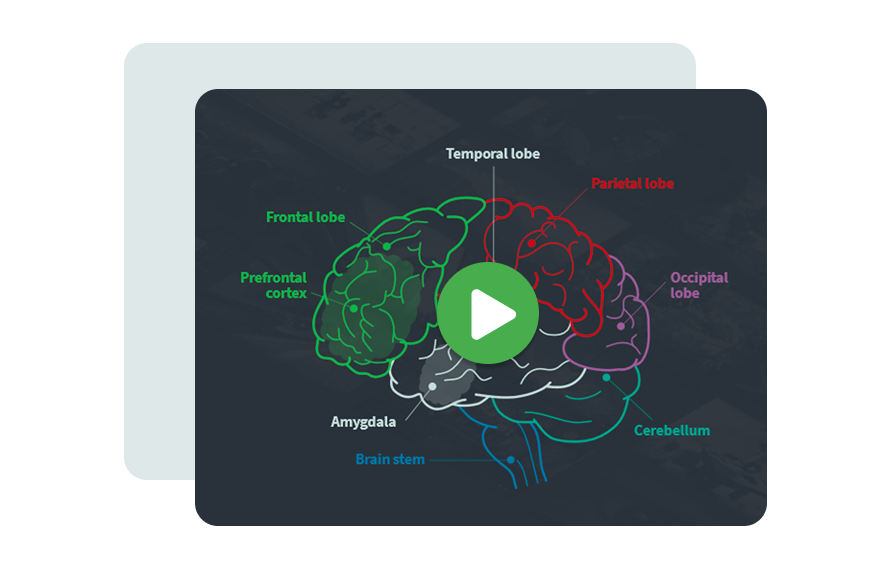
Video doesn’t just speak to the rational mind — it engages the entire brain. It combines information with emotion, makes complex topics easier to grasp, and ensures that messages stick. While text-based content is often quickly forgotten, video captures attention more effectively and creates a more lasting impact.
Put simply: if you want your message to truly land, there’s no way around video.
The numbers make this clear:
- People remember up to 95% of a message when they watch it in a video — compared to only about 10% when reading
- Video generates significantly higher engagement and interaction than static formats
But impact alone isn’t enough.
To be truly effective, video communication needs to be used consistently, strategically, and at scale. And this is exactly where many organizations hit their limits.
The reality: why video communication often falls short

Despite its enormous potential, video communication in many organizations still falls short of expectations.
The issue is rarely a lack of understanding of video’s impact. More often, it comes down to how video production is structured today.
Many corporate communications teams face the same challenges:
- limited time and resources
- complex, often fragmented processes
- high coordination effort across multiple stakeholders
- long production cycles
- lack of scalability
What sounds like a powerful communication tool in theory quickly becomes a bottleneck in practice.
As a result, video is often used only occasionally — for major announcements or one-off campaigns — rather than as a continuous communication format.
Another common issue: too much focus on the production itself, and not enough on the actual communication outcome. Content is created with significant effort, but not always aligned with audience needs or strategic priorities.
The result:
Video communication falls short of its potential — not because it lacks impact, but because the processes behind it hold it back.
The turning point: how AI is redefining video communication

Artificial intelligence addresses exactly the challenges where traditional video processes reach their limits.
But it’s more than just another tool for improving efficiency. AI fundamentally changes the logic of video communication.
What used to be a linear, often time-consuming process is now becoming an intelligent, connected workflow. Individual steps are not only accelerated, but rethought and seamlessly linked together.
The key shift: video is evolving from a resource-heavy one-off project into a scalable communication system.
Instead of:
- long planning and alignment phases
- isolated production steps
- manual, repetitive tasks
AI enables:
- faster idea and content development
- automated and assisted production processes
- consistent communication across formats and channels
This doesn’t just increase speed — it also improves the overall quality of communication.
Because when processes become more efficient, teams gain the space to focus on what really matters: clear messaging, relevant content, and a strong alignment with their audience.
Use case 1: finding the right topics – relevance over gut feeling
The first — and often underestimated — step in video communication is choosing the right topics.
In many organizations, topics are still defined from an internal perspective: What is important for the company? What does management want to communicate?
The problem is that relevance doesn’t come from the sender — it comes from the audience.
This is where AI can make a real difference.
By analyzing data, trends, and sentiment — for example through social listening or internal feedback channels — AI helps identify topics that truly matter to your audience. Instead of relying on assumptions, teams can base decisions on real insights.
This not only improves topic selection, but also prioritization:
Which messages actually support business goals? Which content will have the greatest impact?
The result is communication that doesn’t just get sent — but actually gets noticed.
Use case 2: developing content with precision – from generic to relevant
Once the topic is defined, the next critical step is content creation.
In practice, this is where many teams run into challenges: content is often too generic, not tailored enough to specific audiences, or loses clarity through multiple rounds of feedback and alignment.
AI can significantly simplify — and improve — this process.
With AI-supported script generation, teams can:
- create first drafts in a matter of minutes
- adapt content for different target audiences
- maintain consistent tone and messaging
But the real shift goes one step further.
With the rise of agentic AI, systems are no longer limited to supporting individual tasks. Instead, they can operate autonomously toward defined goals. They analyze context, take audience needs into account, and generate structured content — from the initial idea all the way to a finished script.
This fundamentally changes how teams work. Instead of writing individual prompts, they collaborate with intelligent systems that handle entire process steps and continuously improve over time.
The result is a new way of working: instead of starting from scratch, teams build on structured, high-quality drafts that can be refined and adapted.
What’s important to understand is that AI doesn’t replace strategic thinking — it enhances it.
Or put simply: it’s not about producing more content, but about producing the right content.
Use case 3: scaling video creation – less effort, more output
The biggest bottleneck in video communication is often production itself.
Filming, editing, coordination — all of this requires time and resources. This is exactly where AI has the strongest impact.
New technologies make it possible to create videos faster and with much greater flexibility:
- AI avatars reduce the need for complex video shoots
- AI-generated voices simplify voiceovers and multilingual content
- automated workflows accelerate editing and post-production
This fundamentally changes the role of video within the organization.
What used to be a resource-intensive production process becomes a scalable format that can be adapted to a wide range of use cases — from internal communications and change initiatives to leadership messaging.
Use case 4: building accessibility and reach into your video strategy
Another key lever lies in the accessibility of content.
Especially in large organizations with different locations, languages, and needs, it’s essential that communication reaches as many people as possible.
AI makes this significantly easier.
Automated features such as:
- subtitles
- transcripts
- translations
- metadata
ensure that content is accessible and usable across languages — without additional manual effort.
At the same time, another often overlooked benefit emerges: content becomes structured and searchable. Automatically generated transcripts and metadata make it possible to search within videos, find relevant content faster, and reuse it more efficiently.
This not only improves the discoverability of individual videos, but also enhances overall video management — ensuring that content continues to create value long after it’s been produced.
As a result, video communication becomes not only more efficient, but also more inclusive and sustainably impactful.
Success factors: how to unlock the full potential of AI

As great as the opportunities of AI in video communication are, its success ultimately depends on how it is used.
Not every application automatically leads to better communication. In fact, without a clear strategy, existing problems can even become more pronounced.
One common mistake is treating AI as just another tool to speed up existing processes. The real value, however, only emerges when workflows are rethought holistically.
Three success factors are particularly important:
1. Consistently think from the audience’s perspective
Relevance doesn’t come from internal priorities, but from the needs of the audience. AI can help uncover those needs — but the direction must be intentionally guided.
2. Match content and format to the message
Not every topic fits every format. Effective video communication happens when content, format, and objective are clearly aligned.
3. Use AI as support — not as a replacement
AI can accelerate and structure processes, but it cannot replace a clear communication strategy. Authenticity, intent, and context remain essential.
Common pitfalls: where AI doesn’t help
Alongside the success factors, there are also common patterns that can limit the effectiveness of AI in video communication.
These include:
- One-size-fits-all content
Content is distributed without adapting it to different audiences, which reduces its relevance
- “Sender-centric” messaging instead of audience focus
Communication remains too internally driven and fails to truly resonate with the audience
- Using AI without a clear objective
AI is used simply because it’s available — not because it delivers a defined value
- Lack of authenticity
Content feels generic or interchangeable and loses credibility
These pitfalls highlight an important truth: AI is not a silver bullet.
Or put differently: AI is only powerful when it is used strategically.
What actually changes: more output, less effort, greater impact
When used effectively, AI is already solving many of the core challenges in video communication.
This becomes especially clear in three key areas:
- Output: more content can be produced in less time
- Efficiency: processes become leaner and require fewer coordination steps
- Impact: content becomes more consistent, relevant, and targeted
As a result, the role of video within organizations is fundamentally shifting.
Video is no longer treated as a resource-intensive one-off project, but as an integral part of the communication strategy — scalable, flexible, and continuously usable.
Conclusion: rethinking video communication — now is the time
Today, video is the most powerful format in corporate communications.
For the first time, artificial intelligence makes it possible to fully unlock that potential — not just in isolated cases, but in a scalable and strategic way.
For corporate communications teams, this marks a clear shift:
away from individual, resource-intensive productions — toward structured, efficient workflows.
Those who start embracing these possibilities early lay the foundation for communication that is not only faster and more efficient, but above all, more effective.
.avif)


.avif)
Our Speakers
In theory, video has long been established as a core format in corporate communications. Few other formats communicate messages as emotionally, clearly, and memorably.
And yet, reality often looks different. In many organizations, video is still used only occasionally instead of being treated as a fixed part of the communication strategy.
The reason is not a lack of awareness of video’s effectiveness, but the structures behind it. Too complex, too time-consuming, too difficult to scale — that is how many teams experience video production in day-to-day communications.
This is exactly where artificial intelligence comes in. It does not just improve individual steps in the process. It changes the entire model: video communication shifts from a resource-heavy one-off project to a scalable system.
Why video is essential in corporate communications
Corporate communications has a clear purpose: to provide direction, build trust, and bring people across the organization along the journey.
For that to work, messages don’t just need to be delivered — they need to be understood and remembered.
This is where video shows its greatest strength.
Video doesn’t just speak to the rational mind — it engages the entire brain. It combines information with emotion, makes complex topics easier to grasp, and ensures that messages stick. While text-based content is often quickly forgotten, video captures attention more effectively and creates a more lasting impact.
Put simply: if you want your message to truly land, there’s no way around video.
The numbers make this clear:
- People remember up to 95% of a message when they watch it in a video — compared to only about 10% when reading
- Video generates significantly higher engagement and interaction than static formats
But impact alone isn’t enough.
To be truly effective, video communication needs to be used consistently, strategically, and at scale. And this is exactly where many organizations hit their limits.
The reality: why video communication often falls short
Despite its enormous potential, video communication in many organizations still falls short of expectations.
The issue is rarely a lack of understanding of video’s impact. More often, it comes down to how video production is structured today.
Many corporate communications teams face the same challenges:
- limited time and resources
- complex, often fragmented processes
- high coordination effort across multiple stakeholders
- long production cycles
- lack of scalability
What sounds like a powerful communication tool in theory quickly becomes a bottleneck in practice.
As a result, video is often used only occasionally — for major announcements or one-off campaigns — rather than as a continuous communication format.
Another common issue: too much focus on the production itself, and not enough on the actual communication outcome. Content is created with significant effort, but not always aligned with audience needs or strategic priorities.
The result:
Video communication falls short of its potential — not because it lacks impact, but because the processes behind it hold it back.
The turning point: how AI is redefining video communication
Artificial intelligence addresses exactly the challenges where traditional video processes reach their limits.
But it’s more than just another tool for improving efficiency. AI fundamentally changes the logic of video communication.
What used to be a linear, often time-consuming process is now becoming an intelligent, connected workflow. Individual steps are not only accelerated, but rethought and seamlessly linked together.
The key shift: video is evolving from a resource-heavy one-off project into a scalable communication system.
Instead of:
- long planning and alignment phases
- isolated production steps
- manual, repetitive tasks
AI enables:
- faster idea and content development
- automated and assisted production processes
- consistent communication across formats and channels
This doesn’t just increase speed — it also improves the overall quality of communication.
Because when processes become more efficient, teams gain the space to focus on what really matters: clear messaging, relevant content, and a strong alignment with their audience.
Use case 1: finding the right topics – relevance over gut feeling
The first — and often underestimated — step in video communication is choosing the right topics.
In many organizations, topics are still defined from an internal perspective: What is important for the company? What does management want to communicate?
The problem is that relevance doesn’t come from the sender — it comes from the audience.
This is where AI can make a real difference.
By analyzing data, trends, and sentiment — for example through social listening or internal feedback channels — AI helps identify topics that truly matter to your audience. Instead of relying on assumptions, teams can base decisions on real insights.
This not only improves topic selection, but also prioritization:
Which messages actually support business goals? Which content will have the greatest impact?
The result is communication that doesn’t just get sent — but actually gets noticed.
Use case 2: developing content with precision – from generic to relevant
Once the topic is defined, the next critical step is content creation.
In practice, this is where many teams run into challenges: content is often too generic, not tailored enough to specific audiences, or loses clarity through multiple rounds of feedback and alignment.
AI can significantly simplify — and improve — this process.
With AI-supported script generation, teams can:
- create first drafts in a matter of minutes
- adapt content for different target audiences
- maintain consistent tone and messaging
But the real shift goes one step further.
With the rise of agentic AI, systems are no longer limited to supporting individual tasks. Instead, they can operate autonomously toward defined goals. They analyze context, take audience needs into account, and generate structured content — from the initial idea all the way to a finished script.
This fundamentally changes how teams work. Instead of writing individual prompts, they collaborate with intelligent systems that handle entire process steps and continuously improve over time.
The result is a new way of working: instead of starting from scratch, teams build on structured, high-quality drafts that can be refined and adapted.
What’s important to understand is that AI doesn’t replace strategic thinking — it enhances it.
Or put simply: it’s not about producing more content, but about producing the right content.
Use case 3: scaling video creation – less effort, more output
The biggest bottleneck in video communication is often production itself.
Filming, editing, coordination — all of this requires time and resources. This is exactly where AI has the strongest impact.
New technologies make it possible to create videos faster and with much greater flexibility:
- AI avatars reduce the need for complex video shoots
- AI-generated voices simplify voiceovers and multilingual content
- automated workflows accelerate editing and post-production
This fundamentally changes the role of video within the organization.
What used to be a resource-intensive production process becomes a scalable format that can be adapted to a wide range of use cases — from internal communications and change initiatives to leadership messaging.
Use case 4: building accessibility and reach into your video strategy
Another key lever lies in the accessibility of content.
Especially in large organizations with different locations, languages, and needs, it’s essential that communication reaches as many people as possible.
AI makes this significantly easier.
Automated features such as:
- subtitles
- transcripts
- translations
- metadata
ensure that content is accessible and usable across languages — without additional manual effort.
At the same time, another often overlooked benefit emerges: content becomes structured and searchable. Automatically generated transcripts and metadata make it possible to search within videos, find relevant content faster, and reuse it more efficiently.
This not only improves the discoverability of individual videos, but also enhances overall video management — ensuring that content continues to create value long after it’s been produced.
As a result, video communication becomes not only more efficient, but also more inclusive and sustainably impactful.
Success factors: how to unlock the full potential of AI
As great as the opportunities of AI in video communication are, its success ultimately depends on how it is used.
Not every application automatically leads to better communication. In fact, without a clear strategy, existing problems can even become more pronounced.
One common mistake is treating AI as just another tool to speed up existing processes. The real value, however, only emerges when workflows are rethought holistically.
Three success factors are particularly important:
1. Consistently think from the audience’s perspective
Relevance doesn’t come from internal priorities, but from the needs of the audience. AI can help uncover those needs — but the direction must be intentionally guided.
2. Match content and format to the message
Not every topic fits every format. Effective video communication happens when content, format, and objective are clearly aligned.
3. Use AI as support — not as a replacement
AI can accelerate and structure processes, but it cannot replace a clear communication strategy. Authenticity, intent, and context remain essential.
Common pitfalls: where AI doesn’t help
Alongside the success factors, there are also common patterns that can limit the effectiveness of AI in video communication.
These include:
- One-size-fits-all content
Content is distributed without adapting it to different audiences, which reduces its relevance
- “Sender-centric” messaging instead of audience focus
Communication remains too internally driven and fails to truly resonate with the audience
- Using AI without a clear objective
AI is used simply because it’s available — not because it delivers a defined value
- Lack of authenticity
Content feels generic or interchangeable and loses credibility
These pitfalls highlight an important truth: AI is not a silver bullet.
Or put differently: AI is only powerful when it is used strategically.
What actually changes: more output, less effort, greater impact
When used effectively, AI is already solving many of the core challenges in video communication.
This becomes especially clear in three key areas:
- Output: more content can be produced in less time
- Efficiency: processes become leaner and require fewer coordination steps
- Impact: content becomes more consistent, relevant, and targeted
As a result, the role of video within organizations is fundamentally shifting.
Video is no longer treated as a resource-intensive one-off project, but as an integral part of the communication strategy — scalable, flexible, and continuously usable.
Conclusion: rethinking video communication — now is the time
Today, video is the most powerful format in corporate communications.
For the first time, artificial intelligence makes it possible to fully unlock that potential — not just in isolated cases, but in a scalable and strategic way.
For corporate communications teams, this marks a clear shift:
away from individual, resource-intensive productions — toward structured, efficient workflows.
Those who start embracing these possibilities early lay the foundation for communication that is not only faster and more efficient, but above all, more effective.

Our Speakers
Voices from our customers





.avif)


.avif "Corporate Communications 2027: Agentic AI Webinar")