

Corporate communications with video: the complete guide to strategic, scalable communication in the age of AI

Communication that makes an impact
Corporate communications with video: the complete guide to strategic, scalable communication in the age of AI
Corporate communications at its limit: why traditional approaches no longer work
The demands on corporate communications have increased dramatically in recent years. More channels, more audiences, more content—and at the same time, less and less attention. What used to work with an email or an intranet post is often no longer enough today.
Employees are confronted with information from a wide range of sources every day: meetings, chat tools, emails, internal platforms. In this flood of content, even important communication is quickly overlooked or only skimmed. The result: messages may reach people—but they don’t truly land.
At the same time, expectations of Corporate Communications are rising. Content is no longer expected to simply inform, but to be clear, relevant, and ideally engaging on an emotional level. Leaders are expected to provide direction, changes must be communicated clearly, and company culture needs to be tangible—across locations, languages, and hierarchies.
This pushes many communication teams to their limits. While demands continue to grow, resources, time, and processes often stay the same. Communication becomes a bottleneck—not because it is losing importance, but because it can no longer keep pace with the speed and complexity of the business.
This is where the shift begins: organizations need to rethink how they communicate—moving away from static formats toward formats that capture attention, improve understanding, and can be scaled efficiently.
Why video is becoming essential in corporate communications

When traditional formats reach their limits, the question becomes inevitable: Which formats still capture attention—and actually get messages across?
More and more often, the answer is video.
Communication behavior has fundamentally changed—not just in people’s personal lives, but also in the workplace. Employees are used to consuming information quickly, visually, and on demand. Studies show that visual content is processed much faster than text and is more likely to be remembered.
Video meets this need perfectly. It combines visuals, audio, and context in a way that is far easier to grasp than text alone. Complex topics can be explained more clearly, messages can carry emotional weight, and information can be delivered in less time. At the same time, video has been proven to drive higher engagement: content that includes video consistently outperforms text-based formats.
Comprehension also improves significantly. A large share of people say they understand information better when it is explained visually—an important advantage, especially for complex topics like change initiatives or strategic priorities.
Another key factor: video creates a sense of connection. Leaders become more visible and relatable, and messages feel more personal and authentic. This is particularly important in times of change, remote work, and distributed teams, where direct communication is often limited.
All of this makes one thing clear: video is no longer a complementary format. It is becoming a core component of modern corporate communications—across both internal and external channels.
Yet despite these clear advantages, a familiar pattern emerges in practice: while many organizations recognize the potential of video, it is still often used only in isolated cases. And that’s where the next challenge begins.
What is video communication in corporate communications?
The benefits of video in corporate communications
The growing importance of video in corporate communications is no coincidence. It offers a range of advantages that traditional communication formats struggle to deliver—especially in a work environment defined by speed, complexity, and information overload.
- Greater attention and reach
Video stands out. In an environment where text is often skimmed or skipped entirely, video makes content more visible and keeps audiences engaged for longer. This increases not only the likelihood that messages are seen, but also that they are actually consumed.
- Better understanding of complex topics
When it comes to strategic topics, change initiatives, or new processes, text formats quickly reach their limits. Video makes it easier to explain content visually, clarify relationships, and structure information more clearly. This reduces misunderstandings and improves overall clarity.
- Stronger emotional impact and sense of connection
Communication is not just about sharing information—it’s about building connection. Video conveys tone, facial expressions, and context, making messages feel more personal and tangible. Leaders become more visible, and company culture becomes more relatable.
- Higher retention
Content delivered through both visual and auditory channels is proven to be more memorable. This is especially important for messages that are meant to have a lasting impact, such as during change processes or strategic initiatives.
- Flexibility and cross-channel use
A single video can be used across multiple channels: intranet, email, collaboration tools, or external platforms. Content can be reused, adapted, and embedded in different contexts, increasing its overall value and lifespan.
These advantages make it clear that video is more than just another format. It is transforming how organizations communicate—and laying the foundation for communication that is both more effective and more scalable.
At the same time, one thing becomes evident in practice: despite these benefits, video is often not used systematically. To understand why, it’s worth taking a closer look at where and how video is actually being used in corporate communications.
Use cases: where video drives real impact in corporate communications

The benefits of video are clear—but what really matters is how and where organizations use it. Only when applied strategically across different communication areas does video unlock its full potential.
In practice, one thing becomes evident: video can support almost every aspect of corporate communications—both internally and externally.
Internal communications
Video is particularly powerful in internal communications, where information needs to be delivered quickly, clearly, and often across locations and teams.
Typical use cases include:
- CEO and leadership communication
Strategic messages become more personal and tangible when delivered directly by leadership. - Change communication
Video helps explain change in a more visual and emotional way, making it easier to address uncertainty. - Onboarding and training
Knowledge can be delivered at scale while remaining consistent and easy to understand. - Regular updates and internal formats
Ongoing communication becomes more accessible and easier to maintain.
How video is specifically used in internal communications—and how to overcome common challenges—is explored in more detail in this article.
External corporate communications
Video is also becoming increasingly important in external communications. Organizations face the challenge of conveying complex information in a way that is both clear and compelling.
Typical use cases:
- Corporate messaging and company communication
Content becomes more engaging and easier to understand. - PR and company updates
Video increases visibility and makes messages more adaptable across channels. - Investor relations
Complex information can be communicated more clearly and transparently.
Employer branding and HR
In the competition for talent, communication plays a critical role. Video helps bring company culture to life and convey it authentically.
Typical use cases:
- Recruitment videos
Job opportunities become more tangible and differentiated. - Insights into culture and day-to-day work
Candidates gain a realistic impression of the organization. - Employee stories and testimonials
Authentic perspectives help build trust.
Event and hybrid communication
Events have evolved significantly—and so have the communication requirements before, during, and after them.
Typical use cases:
- Virtual and hybrid events
Reach and accessibility are significantly increased. - Event follow-up and content reuse
Content can be used sustainably and distributed multiple times. - Global communication
Content reaches diverse audiences regardless of location or time zone.
These use cases make it clear: video is not an isolated tool, but a versatile communication asset that can be applied across the entire corporate communications landscape.
At the same time, a central tension becomes visible: as the number of use cases grows, so does the demand for video. And this is exactly where many teams begin to reach their limits.
Why video in corporate communications often doesn’t scale

The wide range of video use cases is exactly what makes it challenging for many communication teams.
In practice, a recurring pattern emerges: while video is recognized as a highly effective format, it is rarely used consistently or strategically. Instead, it remains limited to isolated initiatives—a CEO video here, an event recap there.
The issue is usually not a lack of understanding of video’s value. More often, structural and operational barriers prevent broader adoption.
One of the main factors is production effort. Traditional video production is time-consuming, requires coordination across multiple stakeholders, and relies on internal or external resources. This quickly leads to the perception that video is too complex and not suitable for regular use.
On top of that, long approval processes slow things down. Content needs to be reviewed, adjusted, and often revised multiple times—making it difficult to keep up with the speed modern communication demands.
Limited resources and skills also play a role. Many Corporate Communications teams are not set up to produce video content continuously. There is often a lack of clear processes, the right tools, or simply the time within day-to-day operations.
As a result, video is often treated as a one-off initiative rather than an integral part of the communication strategy. Content is produced, but rarely reused or systematically distributed across channels.
The real problem, then, is not video itself—but how it is used.
As the number of use cases increases, so does the demand for content. And without scalable processes in place, this quickly becomes a bottleneck.
The key question is no longer whether organizations should use video—but how to do so in a way that is sustainable and efficient.
From one-off initiatives to strategy: how successful teams rethink video
If video communication doesn’t fail because of its potential, but because of how it’s implemented, then the solution is not more individual videos—it’s a different approach.
Today, successful Corporate Communications teams no longer treat video as a special project, but as an integral part of their everyday communication mix.
This shift is reflected in three key changes:
Video becomes part of daily communication—not the exception
Instead of producing individual videos for special occasions, teams integrate video into their regular formats: leadership updates, project communication, internal campaigns, or recurring status updates. Video doesn’t replace everything—but it is used deliberately where attention and clarity matter most.
Content is designed for multiple formats from the start
A CEO message is no longer just a single video. It becomes the foundation for short clips, intranet posts, or tailored content for different audiences. This increases output without a proportional increase in effort.
Processes are simplified and standardized
Rather than starting from scratch each time, successful teams rely on clear workflows: recurring formats, defined approval processes, and structured production. Content is often created in batches—for example, recording multiple episodes or updates in one session. This reduces coordination, saves time, and enables a much more efficient content production process.
These changes ensure that video is no longer a bottleneck, but a scalable part of communication.
At the same time, it becomes clear that even with the right processes in place, teams eventually reach their limits. As demand increases, so does the pressure to produce content faster, more frequently, and for a wider range of audiences.
This raises a critical question: how can this demand be met without overloading existing resources?
This is where the next key lever comes into play.
How AI makes video communication scalable
Even with clear processes and a well-defined strategy, one challenge remains: video communication takes time. Content needs to be created, edited, adapted, and tailored for different audiences.
This is where AI comes in.
Rather than introducing entirely new possibilities, AI primarily makes existing processes significantly more efficient. It has the greatest impact where manual work, coordination, or repetitive tasks still consume the most time.
One key lever is the automation of time-intensive tasks. Subtitles, transcripts, and translations can now be generated and refined in a fraction of the time. This not only reduces production effort but also makes content more accessible and easier to use across international teams.
AI also opens up new opportunities for content repurposing. A longer video can be automatically turned into shorter clips, summaries, or text-based formats. This makes it easier to distribute content across multiple channels without having to create each asset from scratch.
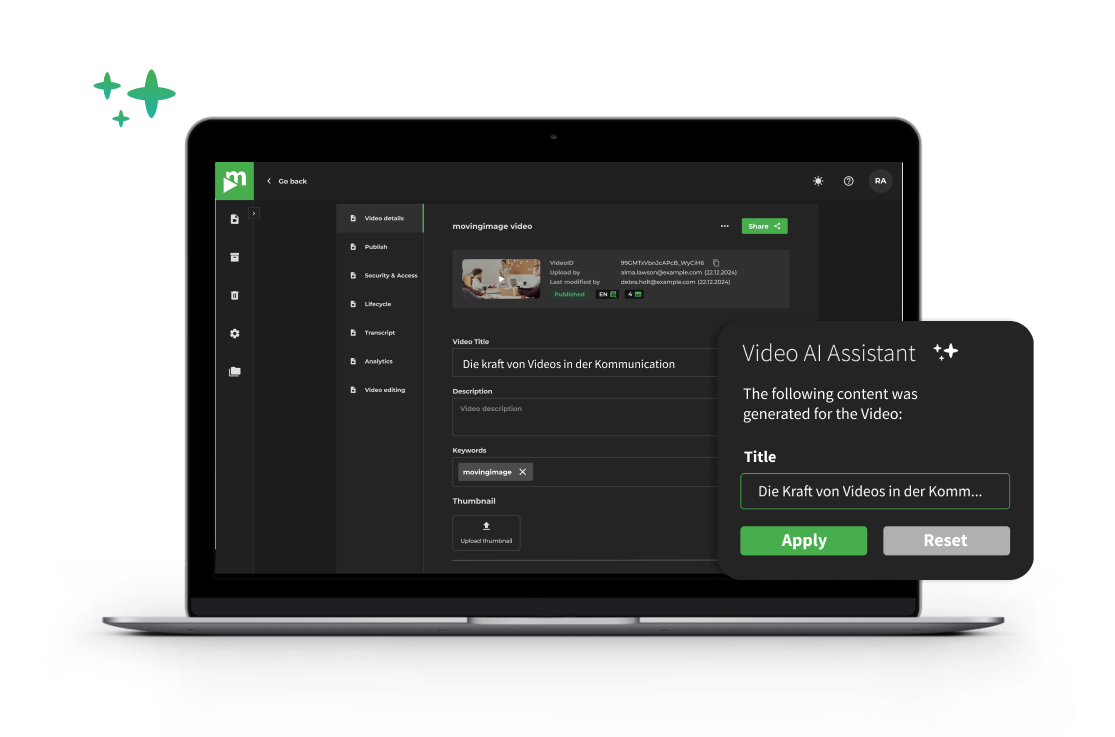
An often overlooked but critical factor is the automatic generation of metadata. AI can analyze content and enrich videos with tags, descriptions, chapters, or topics. This significantly improves content discoverability—both on internal platforms and external channels. As video libraries grow, this becomes a key building block for efficient video management and long-term content usage.
Another important aspect is speed. Content can be created, adapted, and published faster. In internal communications, where timeliness is often crucial, this becomes a clear advantage.
AI also enables a higher degree of personalization. Content can be adapted for different audiences, languages, or contexts—without the effort increasing linearly.
To see how organizations are already using these capabilities in practice—and how intelligent video workflows can improve reach, impact, and efficiency—watch this on-demand webinar on AI in Corporate Communications.
All of this leads to a fundamental shift: video becomes not only easier to produce, but also easier to scale.
At the same time, it’s important to stay grounded. AI does not replace strategy, storytelling, or a deep understanding of your audience. Its real value lies in making existing processes and content more efficient.
In this sense, AI is not an end in itself—it’s an enabler. It makes possible what has long been necessary: video communication that is continuous, relevant, and scalable.
To explore the key developments shaping video communication in the years ahead—and how AI is already unlocking new possibilities—take a look at our overview of the most important AI trends for corporate communications in 2026.
Why Corporate Communications are becoming media teams
When video communication is used strategically and scaled with the help of AI, it doesn’t just change the output—it fundamentally reshapes the role of Corporate Communications.
What was once driven by individual initiatives is evolving into a continuous communication model. Content is no longer created sporadically, but produced, adapted, and distributed on an ongoing basis.
As a result, Corporate Communications teams are increasingly adopting the ways of working typical of media organizations.
This shift is reflected in three key developments:
Continuous content instead of one-off campaigns
Communication is no longer tied to fixed intervals—it becomes part of the daily workflow. Updates, context, and insights are delivered regularly, much like a news or content stream.
More targeted audience communication
Not every message is relevant to everyone. Content is increasingly tailored to specific audiences—based on role, location, or information needs. Video plays a central role here, as it can be easily adapted and customized.
Storytelling as a core capability
The role of Corporate Communications is shifting—from simply delivering information to making it understandable, relevant, and engaging. Content needs to be not only accurate, but also clearly structured and effectively told.
This also raises the bar for teams. Beyond traditional communication skills, new capabilities are becoming essential: content planning, format development, data analysis, and the strategic use of technology.
The real difference, however, lies in mindset. Successful teams no longer see themselves as internal service providers, but as active shapers of communication—continuously developing content and measuring its impact.
This is not a short-term shift, but a structural transformation. Organizations that want to strengthen their communication in a sustainable way can hardly avoid taking this step.
At the same time, a very practical question arises: what does this mean for day-to-day work—and how can teams successfully make this transition?
What successful Corporate Communications teams are doing differently today
The shift toward video-based, scalable communication is no longer a future scenario—it’s already happening. The question is no longer whether organizations will make this move, but how quickly and consistently they act on it.
In practice, successful Corporate Communications teams are doing a few key things differently:
- Video is planned strategically—not produced on the fly
Instead of using video only when needed, it is built into communication planning from the start. Teams define clear formats, recurring use cases, and regular content. This creates consistency and reduces operational effort.
- Technology is used intentionally to streamline processes
Tools are not used in isolation, but as part of a broader system. The goal is to reduce manual work, simplify workflows, and manage and distribute content more efficiently.
- Content is continuously improved based on data
Successful teams don’t rely on gut feeling alone. They analyze what works, how videos are consumed, and where there is room for improvement. Based on these insights, formats are continuously refined and optimized.
- The focus shifts from perfection to speed
Not every video needs to be highly produced. What matters is that content is relevant, clear, and delivered in a timely manner. Teams consciously embrace more pragmatic formats to communicate faster.
- Communication is treated as an ongoing process
Instead of focusing on individual campaigns, successful teams think in terms of continuous communication flows. Content builds on itself and evolves based on the needs of different audiences.
These changes make one thing clear: the difference lies less in individual actions and more in how communication is fundamentally approached and organized.
Ultimately, successfully leveraging video requires more than just the right formats—it depends on having the right structures, processes, and technologies in place.
And this is exactly where the long-term success of this transformation is determined.
The future of corporate communications is visual, scalable, and data-driven

The direction is clear: corporate communications will continue to gain momentum in the years ahead. More content, more audiences, more channels—and at the same time, a growing expectation to communicate in ways that are more relevant and easier to understand.
Video will play a central role in this shift. Not as an add-on, but as a core element of communication strategy. Content will be conceived visually, produced faster, and used more flexibly across channels.
At the same time, AI is becoming a standard tool. Not to replace communication, but to make it more efficient—through automation, improved content discoverability, and the ability to personalize communication at scale.
Audience expectations will also continue to rise. Employees expect content that is easy to understand, relevant, and readily accessible. Organizations that meet these expectations will not only communicate more effectively, but also build stronger engagement.
For Corporate Communications, this means one thing: the role is becoming more strategic. Teams actively shape communication, manage content with clear objectives, and continuously measure its impact.
Conclusion: from challenge to opportunity
Corporate communications today face significant challenges—but also a clear opportunity.
Rising complexity, increasing communication demands, and shrinking attention spans make one thing clear: traditional approaches are no longer enough.
Video offers a way to make content more understandable, more tangible, and more impactful. AI provides the means to scale this communication efficiently.
However, the key step is not about adopting individual tools or formats—it’s about a fundamental shift in mindset. Communication needs to become more strategic, more continuous, and more aligned with the needs of different audiences.
Organizations that actively embrace this transformation will not only communicate more effectively—they will turn communication into a true strategic advantage.
.avif)


.avif)
Our Speaker
Corporate communications at its limit: why traditional approaches no longer work
The demands on corporate communications have increased dramatically in recent years. More channels, more audiences, more content—and at the same time, less and less attention. What used to work with an email or an intranet post is often no longer enough today.
Employees are confronted with information from a wide range of sources every day: meetings, chat tools, emails, internal platforms. In this flood of content, even important communication is quickly overlooked or only skimmed. The result: messages may reach people—but they don’t truly land.
At the same time, expectations of Corporate Communications are rising. Content is no longer expected to simply inform, but to be clear, relevant, and ideally engaging on an emotional level. Leaders are expected to provide direction, changes must be communicated clearly, and company culture needs to be tangible—across locations, languages, and hierarchies.
This pushes many communication teams to their limits. While demands continue to grow, resources, time, and processes often stay the same. Communication becomes a bottleneck—not because it is losing importance, but because it can no longer keep pace with the speed and complexity of the business.
This is where the shift begins: organizations need to rethink how they communicate—moving away from static formats toward formats that capture attention, improve understanding, and can be scaled efficiently.
Why video is becoming essential in corporate communications
When traditional formats reach their limits, the question becomes inevitable: Which formats still capture attention—and actually get messages across?
More and more often, the answer is video.
Communication behavior has fundamentally changed—not just in people’s personal lives, but also in the workplace. Employees are used to consuming information quickly, visually, and on demand. Studies show that visual content is processed much faster than text and is more likely to be remembered.
Video meets this need perfectly. It combines visuals, audio, and context in a way that is far easier to grasp than text alone. Complex topics can be explained more clearly, messages can carry emotional weight, and information can be delivered in less time. At the same time, video has been proven to drive higher engagement: content that includes video consistently outperforms text-based formats.
Comprehension also improves significantly. A large share of people say they understand information better when it is explained visually—an important advantage, especially for complex topics like change initiatives or strategic priorities.
Another key factor: video creates a sense of connection. Leaders become more visible and relatable, and messages feel more personal and authentic. This is particularly important in times of change, remote work, and distributed teams, where direct communication is often limited.
All of this makes one thing clear: video is no longer a complementary format. It is becoming a core component of modern corporate communications—across both internal and external channels.
Yet despite these clear advantages, a familiar pattern emerges in practice: while many organizations recognize the potential of video, it is still often used only in isolated cases. And that’s where the next challenge begins.
What is video communication in corporate communications?
The benefits of video in corporate communications
The growing importance of video in corporate communications is no coincidence. It offers a range of advantages that traditional communication formats struggle to deliver—especially in a work environment defined by speed, complexity, and information overload.
- Greater attention and reach
Video stands out. In an environment where text is often skimmed or skipped entirely, video makes content more visible and keeps audiences engaged for longer. This increases not only the likelihood that messages are seen, but also that they are actually consumed.
- Better understanding of complex topics
When it comes to strategic topics, change initiatives, or new processes, text formats quickly reach their limits. Video makes it easier to explain content visually, clarify relationships, and structure information more clearly. This reduces misunderstandings and improves overall clarity.
- Stronger emotional impact and sense of connection
Communication is not just about sharing information—it’s about building connection. Video conveys tone, facial expressions, and context, making messages feel more personal and tangible. Leaders become more visible, and company culture becomes more relatable.
- Higher retention
Content delivered through both visual and auditory channels is proven to be more memorable. This is especially important for messages that are meant to have a lasting impact, such as during change processes or strategic initiatives.
- Flexibility and cross-channel use
A single video can be used across multiple channels: intranet, email, collaboration tools, or external platforms. Content can be reused, adapted, and embedded in different contexts, increasing its overall value and lifespan.
These advantages make it clear that video is more than just another format. It is transforming how organizations communicate—and laying the foundation for communication that is both more effective and more scalable.
At the same time, one thing becomes evident in practice: despite these benefits, video is often not used systematically. To understand why, it’s worth taking a closer look at where and how video is actually being used in corporate communications.
Use cases: where video drives real impact in corporate communications
The benefits of video are clear—but what really matters is how and where organizations use it. Only when applied strategically across different communication areas does video unlock its full potential.
In practice, one thing becomes evident: video can support almost every aspect of corporate communications—both internally and externally.
Internal communications
Video is particularly powerful in internal communications, where information needs to be delivered quickly, clearly, and often across locations and teams.
Typical use cases include:
- CEO and leadership communication
Strategic messages become more personal and tangible when delivered directly by leadership. - Change communication
Video helps explain change in a more visual and emotional way, making it easier to address uncertainty. - Onboarding and training
Knowledge can be delivered at scale while remaining consistent and easy to understand. - Regular updates and internal formats
Ongoing communication becomes more accessible and easier to maintain.
How video is specifically used in internal communications—and how to overcome common challenges—is explored in more detail in this article.
External corporate communications
Video is also becoming increasingly important in external communications. Organizations face the challenge of conveying complex information in a way that is both clear and compelling.
Typical use cases:
- Corporate messaging and company communication
Content becomes more engaging and easier to understand. - PR and company updates
Video increases visibility and makes messages more adaptable across channels. - Investor relations
Complex information can be communicated more clearly and transparently.
Employer branding and HR
In the competition for talent, communication plays a critical role. Video helps bring company culture to life and convey it authentically.
Typical use cases:
- Recruitment videos
Job opportunities become more tangible and differentiated. - Insights into culture and day-to-day work
Candidates gain a realistic impression of the organization. - Employee stories and testimonials
Authentic perspectives help build trust.
Event and hybrid communication
Events have evolved significantly—and so have the communication requirements before, during, and after them.
Typical use cases:
- Virtual and hybrid events
Reach and accessibility are significantly increased. - Event follow-up and content reuse
Content can be used sustainably and distributed multiple times. - Global communication
Content reaches diverse audiences regardless of location or time zone.
These use cases make it clear: video is not an isolated tool, but a versatile communication asset that can be applied across the entire corporate communications landscape.
At the same time, a central tension becomes visible: as the number of use cases grows, so does the demand for video. And this is exactly where many teams begin to reach their limits.
Why video in corporate communications often doesn’t scale
The wide range of video use cases is exactly what makes it challenging for many communication teams.
In practice, a recurring pattern emerges: while video is recognized as a highly effective format, it is rarely used consistently or strategically. Instead, it remains limited to isolated initiatives—a CEO video here, an event recap there.
The issue is usually not a lack of understanding of video’s value. More often, structural and operational barriers prevent broader adoption.
One of the main factors is production effort. Traditional video production is time-consuming, requires coordination across multiple stakeholders, and relies on internal or external resources. This quickly leads to the perception that video is too complex and not suitable for regular use.
On top of that, long approval processes slow things down. Content needs to be reviewed, adjusted, and often revised multiple times—making it difficult to keep up with the speed modern communication demands.
Limited resources and skills also play a role. Many Corporate Communications teams are not set up to produce video content continuously. There is often a lack of clear processes, the right tools, or simply the time within day-to-day operations.
As a result, video is often treated as a one-off initiative rather than an integral part of the communication strategy. Content is produced, but rarely reused or systematically distributed across channels.
The real problem, then, is not video itself—but how it is used.
As the number of use cases increases, so does the demand for content. And without scalable processes in place, this quickly becomes a bottleneck.
The key question is no longer whether organizations should use video—but how to do so in a way that is sustainable and efficient.
From one-off initiatives to strategy: how successful teams rethink video
If video communication doesn’t fail because of its potential, but because of how it’s implemented, then the solution is not more individual videos—it’s a different approach.
Today, successful Corporate Communications teams no longer treat video as a special project, but as an integral part of their everyday communication mix.
This shift is reflected in three key changes:
Video becomes part of daily communication—not the exception
Instead of producing individual videos for special occasions, teams integrate video into their regular formats: leadership updates, project communication, internal campaigns, or recurring status updates. Video doesn’t replace everything—but it is used deliberately where attention and clarity matter most.
Content is designed for multiple formats from the start
A CEO message is no longer just a single video. It becomes the foundation for short clips, intranet posts, or tailored content for different audiences. This increases output without a proportional increase in effort.
Processes are simplified and standardized
Rather than starting from scratch each time, successful teams rely on clear workflows: recurring formats, defined approval processes, and structured production. Content is often created in batches—for example, recording multiple episodes or updates in one session. This reduces coordination, saves time, and enables a much more efficient content production process.
These changes ensure that video is no longer a bottleneck, but a scalable part of communication.
At the same time, it becomes clear that even with the right processes in place, teams eventually reach their limits. As demand increases, so does the pressure to produce content faster, more frequently, and for a wider range of audiences.
This raises a critical question: how can this demand be met without overloading existing resources?
This is where the next key lever comes into play.
How AI makes video communication scalable
Even with clear processes and a well-defined strategy, one challenge remains: video communication takes time. Content needs to be created, edited, adapted, and tailored for different audiences.
This is where AI comes in.
Rather than introducing entirely new possibilities, AI primarily makes existing processes significantly more efficient. It has the greatest impact where manual work, coordination, or repetitive tasks still consume the most time.
One key lever is the automation of time-intensive tasks. Subtitles, transcripts, and translations can now be generated and refined in a fraction of the time. This not only reduces production effort but also makes content more accessible and easier to use across international teams.
AI also opens up new opportunities for content repurposing. A longer video can be automatically turned into shorter clips, summaries, or text-based formats. This makes it easier to distribute content across multiple channels without having to create each asset from scratch.
An often overlooked but critical factor is the automatic generation of metadata. AI can analyze content and enrich videos with tags, descriptions, chapters, or topics. This significantly improves content discoverability—both on internal platforms and external channels. As video libraries grow, this becomes a key building block for efficient video management and long-term content usage.
Another important aspect is speed. Content can be created, adapted, and published faster. In internal communications, where timeliness is often crucial, this becomes a clear advantage.
AI also enables a higher degree of personalization. Content can be adapted for different audiences, languages, or contexts—without the effort increasing linearly.
To see how organizations are already using these capabilities in practice—and how intelligent video workflows can improve reach, impact, and efficiency—watch this on-demand webinar on AI in Corporate Communications.
All of this leads to a fundamental shift: video becomes not only easier to produce, but also easier to scale.
At the same time, it’s important to stay grounded. AI does not replace strategy, storytelling, or a deep understanding of your audience. Its real value lies in making existing processes and content more efficient.
In this sense, AI is not an end in itself—it’s an enabler. It makes possible what has long been necessary: video communication that is continuous, relevant, and scalable.
To explore the key developments shaping video communication in the years ahead—and how AI is already unlocking new possibilities—take a look at our overview of the most important AI trends for corporate communications in 2026.
Why Corporate Communications are becoming media teams
When video communication is used strategically and scaled with the help of AI, it doesn’t just change the output—it fundamentally reshapes the role of Corporate Communications.
What was once driven by individual initiatives is evolving into a continuous communication model. Content is no longer created sporadically, but produced, adapted, and distributed on an ongoing basis.
As a result, Corporate Communications teams are increasingly adopting the ways of working typical of media organizations.
This shift is reflected in three key developments:
Continuous content instead of one-off campaigns
Communication is no longer tied to fixed intervals—it becomes part of the daily workflow. Updates, context, and insights are delivered regularly, much like a news or content stream.
More targeted audience communication
Not every message is relevant to everyone. Content is increasingly tailored to specific audiences—based on role, location, or information needs. Video plays a central role here, as it can be easily adapted and customized.
Storytelling as a core capability
The role of Corporate Communications is shifting—from simply delivering information to making it understandable, relevant, and engaging. Content needs to be not only accurate, but also clearly structured and effectively told.
This also raises the bar for teams. Beyond traditional communication skills, new capabilities are becoming essential: content planning, format development, data analysis, and the strategic use of technology.
The real difference, however, lies in mindset. Successful teams no longer see themselves as internal service providers, but as active shapers of communication—continuously developing content and measuring its impact.
This is not a short-term shift, but a structural transformation. Organizations that want to strengthen their communication in a sustainable way can hardly avoid taking this step.
At the same time, a very practical question arises: what does this mean for day-to-day work—and how can teams successfully make this transition?
What successful Corporate Communications teams are doing differently today
The shift toward video-based, scalable communication is no longer a future scenario—it’s already happening. The question is no longer whether organizations will make this move, but how quickly and consistently they act on it.
In practice, successful Corporate Communications teams are doing a few key things differently:
- Video is planned strategically—not produced on the fly
Instead of using video only when needed, it is built into communication planning from the start. Teams define clear formats, recurring use cases, and regular content. This creates consistency and reduces operational effort.
- Technology is used intentionally to streamline processes
Tools are not used in isolation, but as part of a broader system. The goal is to reduce manual work, simplify workflows, and manage and distribute content more efficiently.
- Content is continuously improved based on data
Successful teams don’t rely on gut feeling alone. They analyze what works, how videos are consumed, and where there is room for improvement. Based on these insights, formats are continuously refined and optimized.
- The focus shifts from perfection to speed
Not every video needs to be highly produced. What matters is that content is relevant, clear, and delivered in a timely manner. Teams consciously embrace more pragmatic formats to communicate faster.
- Communication is treated as an ongoing process
Instead of focusing on individual campaigns, successful teams think in terms of continuous communication flows. Content builds on itself and evolves based on the needs of different audiences.
These changes make one thing clear: the difference lies less in individual actions and more in how communication is fundamentally approached and organized.
Ultimately, successfully leveraging video requires more than just the right formats—it depends on having the right structures, processes, and technologies in place.
And this is exactly where the long-term success of this transformation is determined.
The future of corporate communications is visual, scalable, and data-driven
The direction is clear: corporate communications will continue to gain momentum in the years ahead. More content, more audiences, more channels—and at the same time, a growing expectation to communicate in ways that are more relevant and easier to understand.
Video will play a central role in this shift. Not as an add-on, but as a core element of communication strategy. Content will be conceived visually, produced faster, and used more flexibly across channels.
At the same time, AI is becoming a standard tool. Not to replace communication, but to make it more efficient—through automation, improved content discoverability, and the ability to personalize communication at scale.
Audience expectations will also continue to rise. Employees expect content that is easy to understand, relevant, and readily accessible. Organizations that meet these expectations will not only communicate more effectively, but also build stronger engagement.
For Corporate Communications, this means one thing: the role is becoming more strategic. Teams actively shape communication, manage content with clear objectives, and continuously measure its impact.
Conclusion: from challenge to opportunity
Corporate communications today face significant challenges—but also a clear opportunity.
Rising complexity, increasing communication demands, and shrinking attention spans make one thing clear: traditional approaches are no longer enough.
Video offers a way to make content more understandable, more tangible, and more impactful. AI provides the means to scale this communication efficiently.
However, the key step is not about adopting individual tools or formats—it’s about a fundamental shift in mindset. Communication needs to become more strategic, more continuous, and more aligned with the needs of different audiences.
Organizations that actively embrace this transformation will not only communicate more effectively—they will turn communication into a true strategic advantage.

Our Speakers
Voices from our customers





.avif)