

Published on
7 practical AI use cases for internal comms teams
Communication that makes an impact
7 practical AI use cases for internal comms teams
Few topics are currently generating as much discussion among communications teams as AI.
While some teams are already experimenting with ChatGPT, Copilot, and other AI tools, others are just getting started. Many are asking the same questions: Which use cases are truly relevant? Where does AI deliver real value? And what possibilities go beyond simply generating text?
At the same time, the pressure on internal communications teams continues to grow. With limited resources, they are expected to manage more channels, reach employees more effectively, and deliver content faster than ever before. On top of that, the volume of communication content keeps increasing—from town hall recordings and CEO messages to training materials and change communications.
This is where AI presents its greatest opportunity.
The most valuable use cases are not limited to creating new content. They emerge wherever AI helps make communication more efficient, scalable, and easier to access.
The following seven use cases show how internal comms teams can already use AI today to save time, extend the reach of their communications, and get more value from existing content.
1. Turn one town hall into 20 communication assets

The challenge
Town halls are one of the most important formats in internal communications. Yet in many organizations, the process still looks the same: the event takes place, the recording is published—and that's where it ends.
The problem is that a single town hall often contains enough content to fuel communications for weeks. Strategic updates, key decisions, employee questions, and leadership insights frequently go underused because no one has the time to repurpose the content afterward.
How AI helps
AI can automatically transcribe, analyze, and transform a town hall into multiple content formats.
For example, a single recording can generate:
- a summary for the intranet
- an article for the internal newsletter
- an FAQ with the most important questions and answers
- topic-specific articles for different audiences
- short highlight clips for internal channels
- chapter markers for easier video navigation
- keywords and metadata to improve discoverability
What once required hours of manual work can now be largely automated.
The benefit
Instead of publishing a message once and moving on, communications teams can significantly extend its reach and reuse content across multiple channels and formats. At the same time, employees can access information in the format that works best for them.
How to get started
Take the recording of your most recent town hall and use AI to create a summary and a list of the key topics discussed. Then consider which additional content formats could be created from that material. Many teams are surprised by how much untapped value already exists in their content.
2. Automatically summarize long videos
The challenge
Whether it's a town hall, a leadership update, or a training session, many important messages are communicated through video. The challenge? Most employees don't have the time to watch a 45- or 60-minute recording from start to finish.
As a result, key messages fail to reach everyone they were intended for—even though the content already exists.
How AI helps
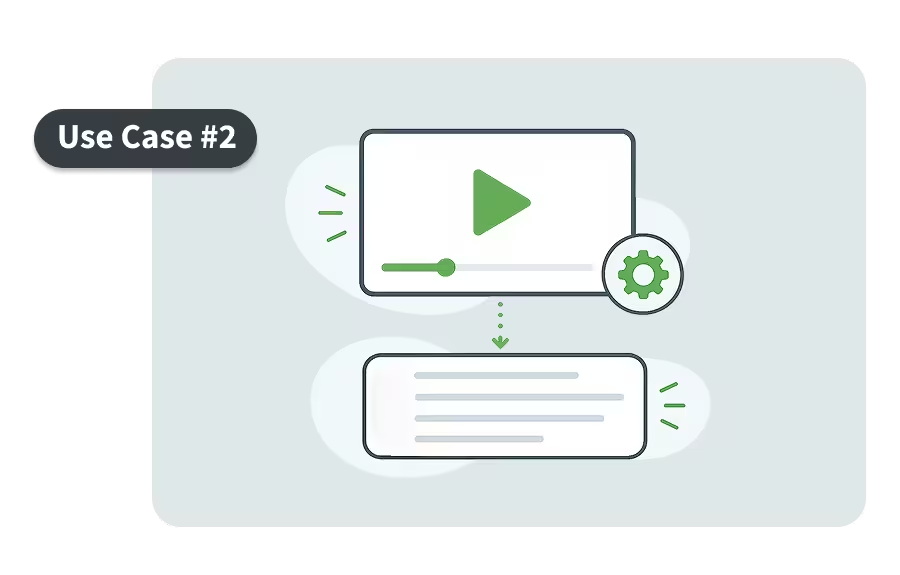
AI can automatically analyze long videos and extract the most important information.
This can include:
- summaries of key takeaways
- executive summaries for leadership teams
- chapter markers for easier navigation
- highlight clips focused on specific topics
- automatically generated questions and answers
- search functionality within the video
Instead of sitting through an entire recording, employees can quickly access the information that is most relevant to them.
The benefit
Long-form video content becomes much easier to consume. At the same time, the likelihood that important messages are actually seen and understood increases significantly.
How to get started
Choose a longer video recording from your internal communications library and use AI to create a short summary with the five most important takeaways. Then add chapter markers or timestamps to help viewers navigate the content. Even this simple step can dramatically improve the viewing experience.
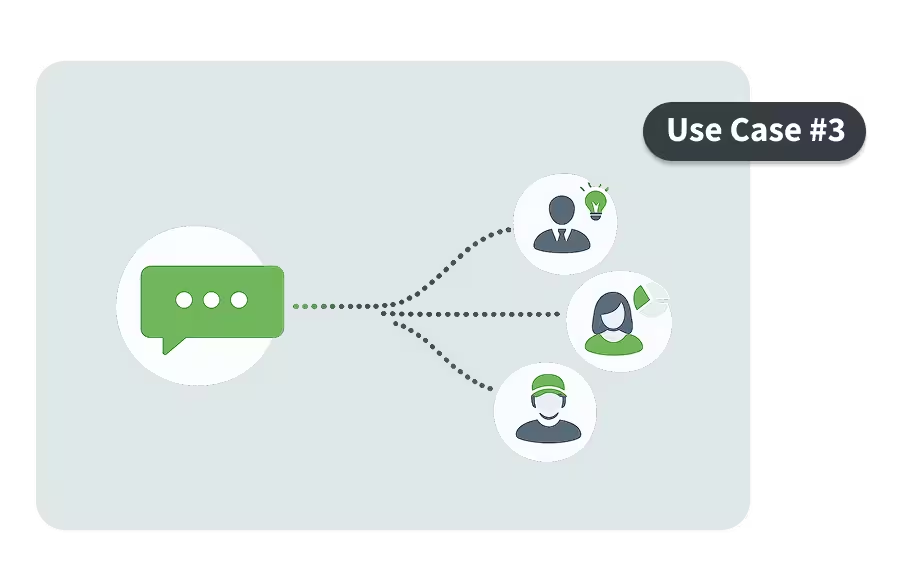
3. Personalize communication for different audiences
The challenge
Internal communications rarely serve a single, homogeneous audience. Employees on the shop floor have different information needs than executives, sales teams, or IT professionals.
Yet many messages are still distributed in a one-size-fits-all format, increasing the risk that parts of the workforce feel the content is not relevant to them.
How AI helps
AI can automatically adapt existing content for different audiences.
For example, a single message can be transformed into:
- an executive summary for leadership teams
- a practical, action-oriented version for operational employees
- regional variations for different locations
- simplified versions for international audiences
- channel-specific formats for the intranet, newsletters, or employee apps
The core message remains consistent, while the language, level of detail, and focus are tailored to the needs of each audience.
The benefit
Communication becomes more relevant, easier to understand, and better aligned with employees' needs. This increases engagement, attention, and acceptance of key messages.
How to get started
Take an existing communication piece and use AI to create two different versions: one for leaders and one for all employees. Then compare how the tone, focus, and level of detail change for each audience.
4. Automatically answer common employee questions

The challenge
When major business initiatives are launched, the same questions tend to come up again and again.
Whether it's a reorganization, a new process, updated policies, or a change management project, communications teams and subject matter experts often spend significant time answering recurring questions. At the same time, employees may struggle to find the information they need or know where to go for answers.
How AI helps
AI can use existing information from videos, documents, intranet articles, and FAQ pages to provide answers to common employee questions automatically.
Examples include:
- answering questions about company initiatives
- supporting change management programs
- helping employees navigate new processes
- enabling employee self-service
- automatically generating FAQs from town halls and Q&A sessions
Employees get answers faster, while communications teams and business stakeholders spend less time responding to repetitive inquiries.
The benefit
Less manual effort, faster access to information, and a better overall employee experience.
How to get started
Review the questions that came in after your most recent town hall, change initiative, or internal campaign. Which ones were asked repeatedly? These recurring questions are often the best place to start exploring AI-powered FAQ and knowledge solutions.
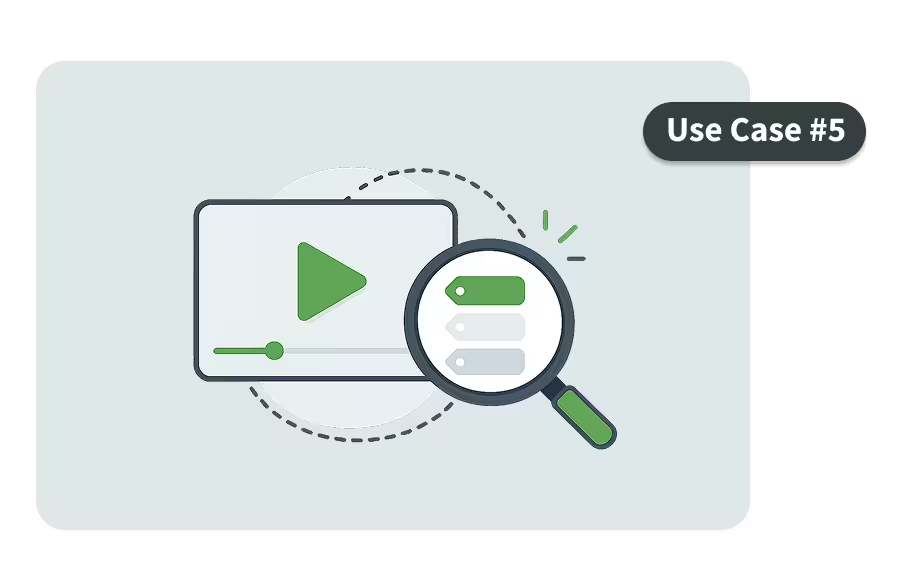
5. Automatically tag and make video content searchable
The challenge
Over the past few years, many organizations have built up an impressive library of video content. Town halls, CEO messages, training sessions, change initiatives, and expert interviews all contain valuable knowledge.
The problem? No one can find it.
Without meaningful titles, descriptions, and tags, valuable content often remains hidden. As a result, communications teams spend time creating new content—even when the answers may already exist in previously recorded videos.
How AI helps
AI can automatically analyze videos and enrich them with relevant metadata.
This can include:
- titles and descriptions
- keywords and tags
- categories
- chapter markers
- topic classifications
- automatically identified people, products, or projects
- transcripts for full-text search
Modern AI solutions go even further by enabling semantic search. Employees no longer need to know which video contains a specific piece of information. Instead, they can simply ask a question and receive the answer they need.
The benefit
Video content evolves from a static archive into a searchable knowledge resource. Information remains accessible long after it was originally published, making content more valuable and easier to reuse over time.
How to get started
Take a look at your video library. How much content could still be useful to employees but is rarely accessed because it is difficult to find? For many organizations, this is where some of the greatest AI opportunities in internal communications can be found.
6. Automate routine communication tasks

The challenge
Most communications teams spend a significant portion of their time on tasks that are necessary but add little strategic value.
Writing meeting notes, translating content, creating subtitles, or managing metadata—all of these activities take time away from higher-impact work.
How AI helps
AI can automate or significantly accelerate many of these repetitive tasks.
Examples include:
- meeting notes and summaries
- translations
- subtitles and captions
- image descriptions for accessibility
- metadata for videos and documents
- content categorization
- quality checks and consistency reviews
This frees up more time for the work that drives real impact: strategic communications, stakeholder consulting, storytelling, and the development of new communication formats.
The benefit
Less time spent on administrative tasks and more time focused on meaningful communication.
How to get started
Identify three tasks your team performs every week that involve little creativity or strategic decision-making. Then assess which of them could already be supported or automated with AI today.
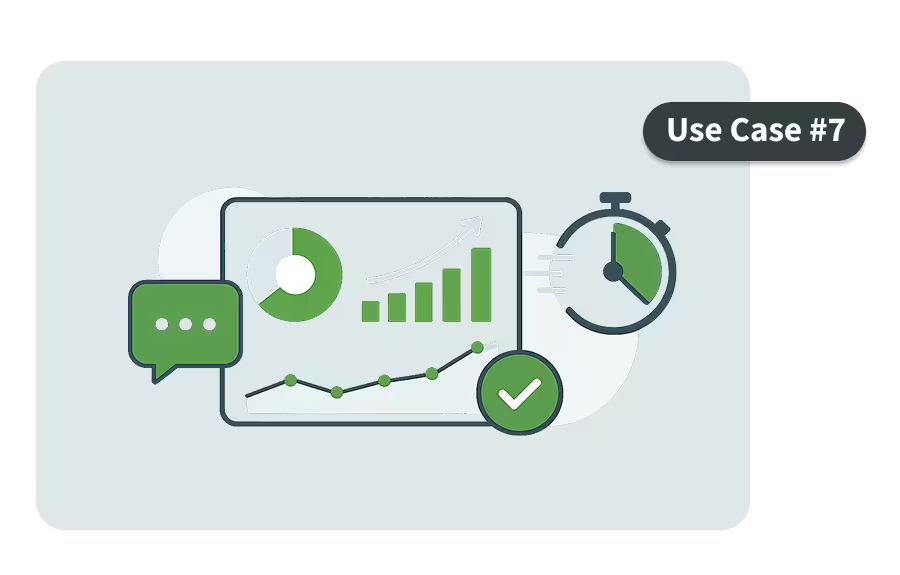
7. Analyze communication performance faster
The challenge
Communications teams invest significant time and effort into creating and distributing content. What is often much harder to determine is whether that content actually had the intended impact.
Which topics resonate most with employees? Which messages are being understood? And where is there still a need for additional communication?
How AI helps
AI can analyze large volumes of feedback and engagement data to uncover patterns and insights.
Examples include:
- comment analysis
- employee feedback analysis
- identification of frequently asked questions
- topic clustering
- sentiment and trend detection
- content performance analysis
Instead of manually reviewing individual responses, communications teams can quickly gain a broader understanding of the topics, concerns, and interests that matter most to their audiences.
The benefit
Decisions are based less on assumptions and more on real insights. This allows teams to plan communication activities more effectively and continuously improve their impact.
How to get started
Use AI to analyze comments, survey responses, or feedback from a recent communication initiative. In many cases, AI will uncover themes and patterns that are easy to miss in a manual review.
Conclusion
Many internal comms teams find themselves at a similar stage today. They know AI will change the way they work, but it is often unclear which use cases are truly relevant and where to start.
The good news is that you do not need a perfect AI strategy to achieve meaningful results.
Whether it is automated summaries, content repurposing, intelligent metadata, or feedback analysis, many AI use cases can already be integrated into existing communication processes and deliver immediate value.
The key is simply to get started. Not every use case will be equally relevant for every team. But organizations that experiment, learn, and continuously refine their processes will quickly discover where AI can provide the greatest support.
The question is no longer whether AI will become part of internal communications. The more interesting question is: Which use cases can help your team unlock the greatest efficiency and impact today?
.avif)


.avif)
FAQs:
1. How can AI support internal communications teams?
AI can help internal comms teams with a wide range of tasks, including content summarization, audience personalization, video tagging, and content analysis. This enables teams to work more efficiently and get more value from existing content.
2. Which AI use cases are the easiest to implement?
Many teams start with automated summaries, transcription, subtitles, or metadata generation for videos. These use cases often require minimal process changes and can deliver immediate benefits.
3. Can AI help make video content more useful?
Yes. AI can automatically transcribe videos, create chapter markers, generate summaries, and add relevant metadata. This makes video content easier to find, consume, and reuse over time.
4. Do we need a comprehensive AI strategy before getting started?
No. Many successful AI initiatives begin with a single, well-defined use case. The key is to start small, gain experience, and identify where AI can create the most value for your communications team.
5. Will AI replace internal communications teams?
AI is not a replacement for strategic communication. Instead, it helps automate repetitive tasks, giving teams more time to focus on storytelling, stakeholder engagement, campaign planning, and other high-value activities.
Our Speaker
Few topics are currently generating as much discussion among communications teams as AI.
While some teams are already experimenting with ChatGPT, Copilot, and other AI tools, others are just getting started. Many are asking the same questions: Which use cases are truly relevant? Where does AI deliver real value? And what possibilities go beyond simply generating text?
At the same time, the pressure on internal communications teams continues to grow. With limited resources, they are expected to manage more channels, reach employees more effectively, and deliver content faster than ever before. On top of that, the volume of communication content keeps increasing—from town hall recordings and CEO messages to training materials and change communications.
This is where AI presents its greatest opportunity.
The most valuable use cases are not limited to creating new content. They emerge wherever AI helps make communication more efficient, scalable, and easier to access.
The following seven use cases show how internal comms teams can already use AI today to save time, extend the reach of their communications, and get more value from existing content.
1. Turn one town hall into 20 communication assets
The challenge
Town halls are one of the most important formats in internal communications. Yet in many organizations, the process still looks the same: the event takes place, the recording is published—and that's where it ends.
The problem is that a single town hall often contains enough content to fuel communications for weeks. Strategic updates, key decisions, employee questions, and leadership insights frequently go underused because no one has the time to repurpose the content afterward.
How AI helps
AI can automatically transcribe, analyze, and transform a town hall into multiple content formats.
For example, a single recording can generate:
- a summary for the intranet
- an article for the internal newsletter
- an FAQ with the most important questions and answers
- topic-specific articles for different audiences
- short highlight clips for internal channels
- chapter markers for easier video navigation
- keywords and metadata to improve discoverability
What once required hours of manual work can now be largely automated.
The benefit
Instead of publishing a message once and moving on, communications teams can significantly extend its reach and reuse content across multiple channels and formats. At the same time, employees can access information in the format that works best for them.
How to get started
Take the recording of your most recent town hall and use AI to create a summary and a list of the key topics discussed. Then consider which additional content formats could be created from that material. Many teams are surprised by how much untapped value already exists in their content.
2. Automatically summarize long videos
The challenge
Whether it's a town hall, a leadership update, or a training session, many important messages are communicated through video. The challenge? Most employees don't have the time to watch a 45- or 60-minute recording from start to finish.
As a result, key messages fail to reach everyone they were intended for—even though the content already exists.
How AI helps
AI can automatically analyze long videos and extract the most important information.
This can include:
- summaries of key takeaways
- executive summaries for leadership teams
- chapter markers for easier navigation
- highlight clips focused on specific topics
- automatically generated questions and answers
- search functionality within the video
Instead of sitting through an entire recording, employees can quickly access the information that is most relevant to them.
The benefit
Long-form video content becomes much easier to consume. At the same time, the likelihood that important messages are actually seen and understood increases significantly.
How to get started
Choose a longer video recording from your internal communications library and use AI to create a short summary with the five most important takeaways. Then add chapter markers or timestamps to help viewers navigate the content. Even this simple step can dramatically improve the viewing experience.
3. Personalize communication for different audiences
The challenge
Internal communications rarely serve a single, homogeneous audience. Employees on the shop floor have different information needs than executives, sales teams, or IT professionals.
Yet many messages are still distributed in a one-size-fits-all format, increasing the risk that parts of the workforce feel the content is not relevant to them.
How AI helps
AI can automatically adapt existing content for different audiences.
For example, a single message can be transformed into:
- an executive summary for leadership teams
- a practical, action-oriented version for operational employees
- regional variations for different locations
- simplified versions for international audiences
- channel-specific formats for the intranet, newsletters, or employee apps
The core message remains consistent, while the language, level of detail, and focus are tailored to the needs of each audience.
The benefit
Communication becomes more relevant, easier to understand, and better aligned with employees' needs. This increases engagement, attention, and acceptance of key messages.
How to get started
Take an existing communication piece and use AI to create two different versions: one for leaders and one for all employees. Then compare how the tone, focus, and level of detail change for each audience.
4. Automatically answer common employee questions
The challenge
When major business initiatives are launched, the same questions tend to come up again and again.
Whether it's a reorganization, a new process, updated policies, or a change management project, communications teams and subject matter experts often spend significant time answering recurring questions. At the same time, employees may struggle to find the information they need or know where to go for answers.
How AI helps
AI can use existing information from videos, documents, intranet articles, and FAQ pages to provide answers to common employee questions automatically.
Examples include:
- answering questions about company initiatives
- supporting change management programs
- helping employees navigate new processes
- enabling employee self-service
- automatically generating FAQs from town halls and Q&A sessions
Employees get answers faster, while communications teams and business stakeholders spend less time responding to repetitive inquiries.
The benefit
Less manual effort, faster access to information, and a better overall employee experience.
How to get started
Review the questions that came in after your most recent town hall, change initiative, or internal campaign. Which ones were asked repeatedly? These recurring questions are often the best place to start exploring AI-powered FAQ and knowledge solutions.
5. Automatically tag and make video content searchable
The challenge
Over the past few years, many organizations have built up an impressive library of video content. Town halls, CEO messages, training sessions, change initiatives, and expert interviews all contain valuable knowledge.
The problem? No one can find it.
Without meaningful titles, descriptions, and tags, valuable content often remains hidden. As a result, communications teams spend time creating new content—even when the answers may already exist in previously recorded videos.
How AI helps
AI can automatically analyze videos and enrich them with relevant metadata.
This can include:
- titles and descriptions
- keywords and tags
- categories
- chapter markers
- topic classifications
- automatically identified people, products, or projects
- transcripts for full-text search
Modern AI solutions go even further by enabling semantic search. Employees no longer need to know which video contains a specific piece of information. Instead, they can simply ask a question and receive the answer they need.
The benefit
Video content evolves from a static archive into a searchable knowledge resource. Information remains accessible long after it was originally published, making content more valuable and easier to reuse over time.
How to get started
Take a look at your video library. How much content could still be useful to employees but is rarely accessed because it is difficult to find? For many organizations, this is where some of the greatest AI opportunities in internal communications can be found.
6. Automate routine communication tasks
The challenge
Most communications teams spend a significant portion of their time on tasks that are necessary but add little strategic value.
Writing meeting notes, translating content, creating subtitles, or managing metadata—all of these activities take time away from higher-impact work.
How AI helps
AI can automate or significantly accelerate many of these repetitive tasks.
Examples include:
- meeting notes and summaries
- translations
- subtitles and captions
- image descriptions for accessibility
- metadata for videos and documents
- content categorization
- quality checks and consistency reviews
This frees up more time for the work that drives real impact: strategic communications, stakeholder consulting, storytelling, and the development of new communication formats.
The benefit
Less time spent on administrative tasks and more time focused on meaningful communication.
How to get started
Identify three tasks your team performs every week that involve little creativity or strategic decision-making. Then assess which of them could already be supported or automated with AI today.
7. Analyze communication performance faster
The challenge
Communications teams invest significant time and effort into creating and distributing content. What is often much harder to determine is whether that content actually had the intended impact.
Which topics resonate most with employees? Which messages are being understood? And where is there still a need for additional communication?
How AI helps
AI can analyze large volumes of feedback and engagement data to uncover patterns and insights.
Examples include:
- comment analysis
- employee feedback analysis
- identification of frequently asked questions
- topic clustering
- sentiment and trend detection
- content performance analysis
Instead of manually reviewing individual responses, communications teams can quickly gain a broader understanding of the topics, concerns, and interests that matter most to their audiences.
The benefit
Decisions are based less on assumptions and more on real insights. This allows teams to plan communication activities more effectively and continuously improve their impact.
How to get started
Use AI to analyze comments, survey responses, or feedback from a recent communication initiative. In many cases, AI will uncover themes and patterns that are easy to miss in a manual review.
Conclusion
Many internal comms teams find themselves at a similar stage today. They know AI will change the way they work, but it is often unclear which use cases are truly relevant and where to start.
The good news is that you do not need a perfect AI strategy to achieve meaningful results.
Whether it is automated summaries, content repurposing, intelligent metadata, or feedback analysis, many AI use cases can already be integrated into existing communication processes and deliver immediate value.
The key is simply to get started. Not every use case will be equally relevant for every team. But organizations that experiment, learn, and continuously refine their processes will quickly discover where AI can provide the greatest support.
The question is no longer whether AI will become part of internal communications. The more interesting question is: Which use cases can help your team unlock the greatest efficiency and impact today?

FAQs:
1. How can AI support internal communications teams?
AI can help internal comms teams with a wide range of tasks, including content summarization, audience personalization, video tagging, and content analysis. This enables teams to work more efficiently and get more value from existing content.
2. Which AI use cases are the easiest to implement?
Many teams start with automated summaries, transcription, subtitles, or metadata generation for videos. These use cases often require minimal process changes and can deliver immediate benefits.
3. Can AI help make video content more useful?
Yes. AI can automatically transcribe videos, create chapter markers, generate summaries, and add relevant metadata. This makes video content easier to find, consume, and reuse over time.
4. Do we need a comprehensive AI strategy before getting started?
No. Many successful AI initiatives begin with a single, well-defined use case. The key is to start small, gain experience, and identify where AI can create the most value for your communications team.
5. Will AI replace internal communications teams?
AI is not a replacement for strategic communication. Instead, it helps automate repetitive tasks, giving teams more time to focus on storytelling, stakeholder engagement, campaign planning, and other high-value activities.
Our Speakers
Voices from our customers





.avif)