
How AI can turn one town hall into 20 pieces of content
Communication that makes an impact
How AI can turn one town hall into 20 pieces of content
The real potential of a town hall begins after the livestream
For many large organizations, town halls are one of the most important formats in internal communications. And they require significant effort: topics need to be aligned, leaders prepared, presentations created, the technical setup put in place, and employees invited across locations, countries, and time zones.
Then the livestream begins. Sixty minutes later, it is over.
The recording may still be published on the intranet or in the video portal so that employees who could not attend live can catch up later. But in many cases, that is where the communication journey ends. And yet those 60 minutes often contain enough content to fuel communication for days or even weeks.
The CEO explains the new corporate strategy. One business unit presents important performance figures. Another team introduces a new project. Leaders answer employee questions. There may also be statements that are relevant for recruiting, external communications, or future leadership updates. All of that content already exists. It does not need to be reinvented or produced from scratch.
Until now, the main challenge has been the effort required to reuse it. Someone had to watch the entire recording, identify relevant moments, note timecodes, cut clips, transcribe statements, write summaries, and adapt content for different channels. That may still be manageable for a single town hall. But with recurring all-hands meetings, leadership updates, and other livestreams, it quickly becomes a significant additional workload for communications teams.
AI changes the equation. It can not only process video content faster, but increasingly help make sense of what is actually inside it: What were the most important topics? Which statements matter most? Where were specific projects mentioned? What questions were asked? Which sequences work as standalone clips? And which parts can be turned into other communication formats?
That also changes the role of the town hall itself. It is no longer just a live event followed by a recording. It can become the starting point for an entire content lifecycle.
From live event to content engine
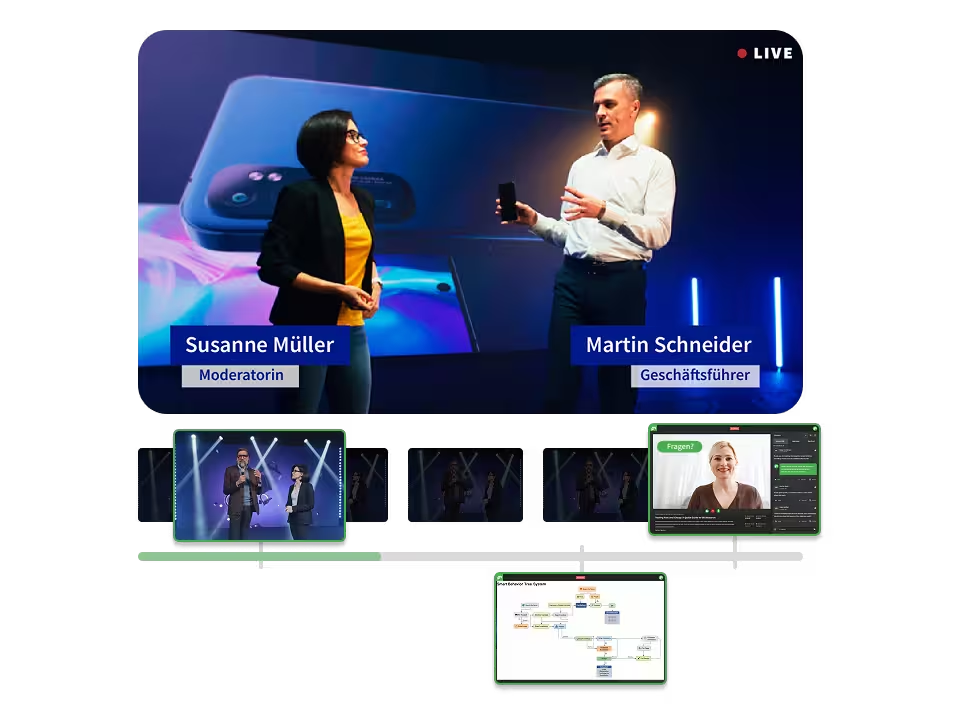
The traditional town hall workflow is linear:
Plan → stream → publish the recording → done.
With AI, that linear process can become an ongoing content lifecycle:
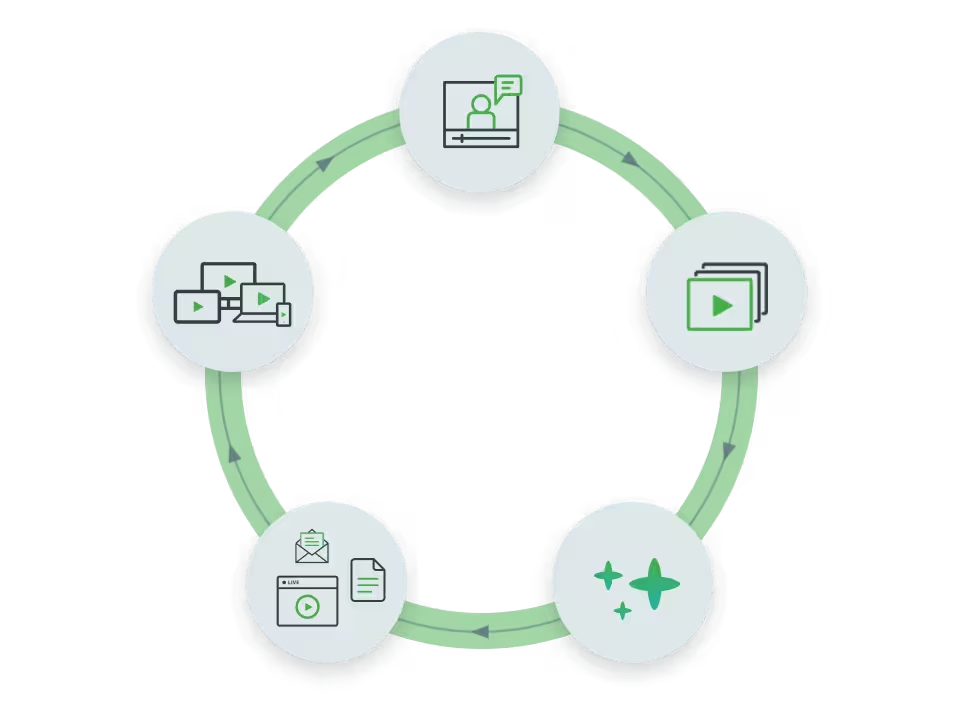
Plan → stream → understand → repurpose → adapt → distribute → make searchable → reuse.
The key difference is that communications teams no longer have to start from scratch for every audience and channel. Instead, the livestream becomes a central source of content.
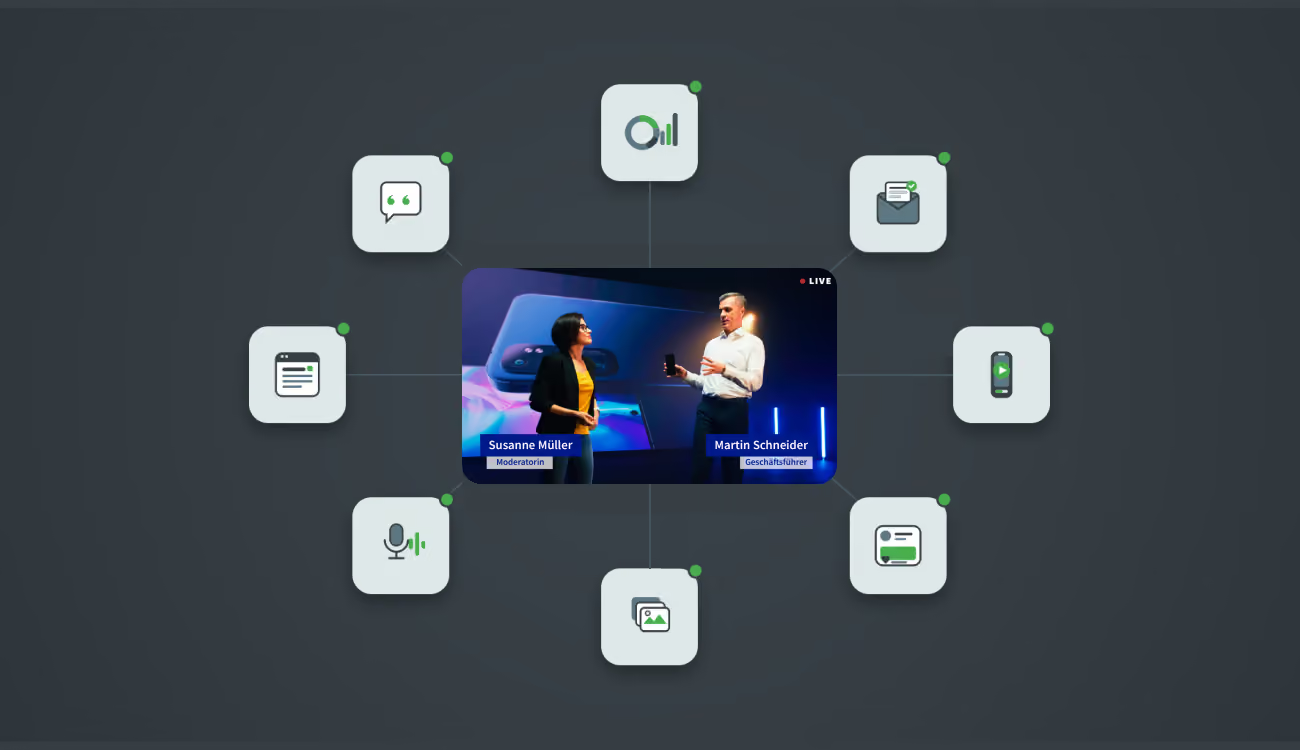
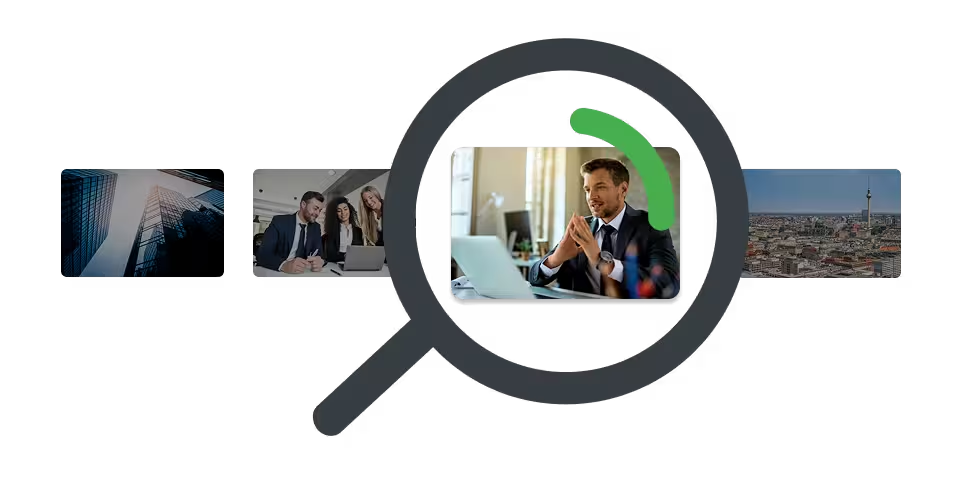
A strategic update can become a short video clip for the intranet. A Q&A session can be turned into an FAQ. The entire event can be summarized for employees who were unable to attend live. Key messages can be tailored for managers and leadership teams. Subtitles and translations can make content accessible to wider audiences. And with intelligent video search, relevant information can still be found months after the event.
This allows communications teams to multiply the impact of a single town hall without multiplying the production effort along with it.
And the potential is significant: one town hall can easily become 20 or more pieces of content.
How one town hall becomes 20 pieces of content
A town hall is an ideal starting point for content repurposing because so many relevant topics already come together in one place. Instead of simply making the entire event available as a 60-minute recording, AI can help identify individual topics, statements, and key moments and turn them into content for different communication needs.
What that looks like will naturally depend on the content of each town hall. But the following 20 examples show just how much communications teams can get out of a single event.
Turn a long livestream into short, relevant video formats
Not every employee has time to watch a 60-minute recording. And often, only certain parts of a town hall are relevant to specific audiences. Instead of repeatedly directing employees to the full recording, communications teams can extract the moments that deliver value on their own.
- On-demand recording: The full town hall remains available for anyone who could not attend live or wants to revisit specific topics later.
- Leadership highlight: The most important message from the CEO or leadership team becomes a standalone clip.
- Strategic update: Key messages about strategy, business performance, or future priorities are condensed into a shorter format.
- Project or initiative clip: Updates on individual projects, organizational changes, or new initiatives are extracted and shared with the audiences they matter to most.
- Q&A highlight: Particularly important or frequently asked questions and their answers are turned into standalone videos.
- Top 3 takeaways: The most important insights from the event are condensed into a short recap video.
- Short clips: Brief excerpts can be distributed across the intranet, internal social channels, and other touchpoints, bringing employees directly to the topics that matter to them.
AI can take on much of the manual groundwork involved. It can create transcripts, identify topics and speakers, structure content into chapters, and make relevant moments within long recordings easier to find. The communications team still decides which messages matter and what should be published — without having to manually search through every minute of footage.
Turn spoken information into written content
The potential of a town hall goes far beyond video. Much of the information shared during the event can also be transformed into written communication. This not only makes the content useful across more channels, but also reaches employees who prefer to read or simply do not have time to watch a video.
- Town hall summary: The most important topics, decisions, and messages are brought together in a concise recap.
- Executive summary: Leaders receive a brief overview of strategic messages, decisions, and relevant next steps.
- Key takeaways article: The main insights are turned into an easy-to-digest article for the intranet or employee app.
- Q&A summary: Questions and answers from the event are documented in a structured format, keeping valuable information accessible after the town hall.
- Intranet article: The central topics become an editorial piece that provides additional context around key messages and links to relevant videos or further information.
- Follow-up email: Employees receive a concise post-event summary featuring the key messages, next steps, and links to additional content.
- Newsletter content: Individual topics and highlights can be incorporated into existing internal newsletters and resurfaced over a longer period of time.
For Corporate Communications teams, the benefit is clear: the same information does not have to be gathered and rewritten from scratch for every format. The town hall becomes the shared source material, while AI helps create initial versions for different communication formats. Editorial oversight remains essential, particularly when dealing with strategic messages, sensitive information, or statements from the leadership team.
Make the same content relevant to different audiences and channels
Content repurposing does not mean simply publishing the same message as often as possible. Effective corporate communications considers who needs a piece of information, why it matters to them, and which channel is most likely to reach them. Here too, the town hall can serve as a shared source of content.
- Leadership briefing: Leaders receive the information they need to communicate with their teams, including relevant decisions, talking points, and next steps.
- Recap for those who missed the event: Employees who could not attend receive a concise version with the most important messages and direct links to relevant video segments.
- LinkedIn content: Statements or topics that are also relevant to external stakeholders can be adapted for external corporate communications.
- Talking points for managers: Key messages are condensed into a format that helps managers communicate them consistently across their teams.
- Employee FAQ: Recurring or particularly relevant questions from the town hall are collected, answered in a structured way, and made permanently accessible.
- Searchable knowledge source: The town hall becomes part of the organization’s long-term knowledge base. Employees can search for specific topics, projects, or statements instead of digging through lengthy recordings months later.
That final example illustrates why this goes beyond traditional content repurposing. A town hall does not simply produce 20 additional pieces of content. The information it contains becomes structured, useful for different audiences, and accessible over the long term. A one-time event becomes a content source that Corporate Communications can continue to draw on long after the livestream ends.
That is why one of the most exciting applications of AI in enterprise video is not generating more and more new content. It is multiplying the value of content that organizations have already invested significant time and resources in creating.
For Corporate Communications, this also shifts the focus. Instead of reviewing every recording from scratch and manually adapting it for individual channels, teams can spend more time curating, evaluating, and directing communication. Which messages should be amplified? Who needs to hear them? And which format will have the greatest impact?
For this to work at scale, however, AI needs a reliable foundation. And that foundation is created during the livestream itself.
Why the content lifecycle starts with the livestream
If you want to get more long-term value from a town hall, you need to think beyond the live event from the start. Everything that follows depends on having high-quality, reliably available source material.
Good video and, in particular, audio quality are essential not only for the live experience, but also for transcription, subtitles, translations, and subsequent AI-powered processing. At the same time, the recording needs to be centrally available after the event and securely integrated into the organization’s existing video and communications infrastructure.
Enterprise town halls add another layer of requirements. Hundreds or thousands of employees need reliable access across locations, permissions must be managed, and sensitive content needs to remain protected. Subtitles and translations may be essential for global workforces, while analytics can provide insights into which audiences were actually reached and how they engaged with the content.
Livestreaming and AI, then, are not separate steps at opposite ends of the communications process. They are part of the same content lifecycle: the livestream creates the central source of content, the video infrastructure keeps it secure and accessible over time, and AI helps unlock the information within it and put it to further use.
For Corporate Communications, this creates a new way of thinking about live communication. The success of a town hall is no longer measured solely by how many employees tuned in live. What happens to the content afterwards — how effectively it can be reused, distributed, and made accessible over the long term — matters just as much.
From content repurposing to content orchestration
Turning one town hall into 20 pieces of content may sound like classic content repurposing. But the real potential of AI goes much further. If every new piece of content still requires a separate prompt, a different tool, and a manual handoff to the next step, AI-powered communication remains fragmented.
The more interesting shift happens when these individual tasks become part of connected workflows. After a town hall, the recording could automatically be made available and transcribed. AI identifies key topics, statements, and questions, suggests relevant highlights, and creates initial drafts for different formats and audiences. Corporate Communications reviews, prioritizes, and approves the content before it is distributed across the right channels.
This turns a series of manual tasks into an orchestrated communications process. And that does not mean handing control over to AI. Quite the opposite: the more tasks can be automated, the more important Corporate Communications becomes as the team directing the process. It defines the messages, audiences, rules, and approval processes and ultimately decides what gets published. AI takes care of much of the work in between.
Looking ahead, AI agents could take this development one step further. Rather than simply responding to individual prompts, they can carry out defined tasks within a communications workflow, pass information between different stages, and work toward predefined goals. An AI assistant that summarizes a town hall could evolve into a system that supports the entire content lifecycle.
For Corporate Communications, this is an important distinction. The biggest efficiency gains do not come from writing one piece of copy faster or transcribing one video more quickly. They come when an entire recurring process changes — from the livestream and content creation to distribution and long-term reuse.
What Corporate Communications gains
The most obvious benefit is time. When teams spend fewer resources reviewing long recordings, searching for relevant moments, and repeatedly repackaging the same information, they have more room for the work where communications expertise really matters: sharpening messages, understanding audiences, planning communication, and measuring its impact.
At the same time, content can reach a much wider audience. A town hall no longer serves only those who attend the livestream or watch the full recording afterwards. Its most important messages can reach the right audiences repeatedly across different formats, channels, and moments in time. For global or decentralized organizations in particular, this makes it easier to adapt communication to different needs.
The investment in the original content also goes further. If organizations are already putting significant time, budget, and resources into high-quality town halls, it makes sense to get as much value as possible from the content they produce. One hour of live communication no longer results in just one recording, but in a content foundation that can continue to deliver value for weeks.
Finally, valuable knowledge remains accessible for longer. Strategic messages, answers from leadership, and information about important initiatives no longer disappear into lengthy video archives. Instead, they can be structured, made searchable, and reused in new contexts. AI can therefore do more than make Corporate Communications more efficient — it can help extend the reach, relevance, and lifespan of corporate communication.
The town hall doesn’t end with the livestream
A town hall remains a unique moment in corporate communications: leaders speak directly to employees, important topics get the attention they deserve, and the organization comes together around a shared moment. But its value does not have to end after 60 minutes.
With the right video infrastructure and AI, that single moment can fuel communication across many more channels, audiences, and occasions. Corporate Communications can make smarter use of existing content instead of starting from scratch for every new touchpoint.
A town hall is no longer just a one-time event. It becomes a source of content that continues to create impact long after the livestream ends.
.avif)


.avif)
Our Speakers
The real potential of a town hall begins after the livestream
For many large organizations, town halls are one of the most important formats in internal communications. And they require significant effort: topics need to be aligned, leaders prepared, presentations created, the technical setup put in place, and employees invited across locations, countries, and time zones.
Then the livestream begins. Sixty minutes later, it is over.
The recording may still be published on the intranet or in the video portal so that employees who could not attend live can catch up later. But in many cases, that is where the communication journey ends. And yet those 60 minutes often contain enough content to fuel communication for days or even weeks.
The CEO explains the new corporate strategy. One business unit presents important performance figures. Another team introduces a new project. Leaders answer employee questions. There may also be statements that are relevant for recruiting, external communications, or future leadership updates. All of that content already exists. It does not need to be reinvented or produced from scratch.
Until now, the main challenge has been the effort required to reuse it. Someone had to watch the entire recording, identify relevant moments, note timecodes, cut clips, transcribe statements, write summaries, and adapt content for different channels. That may still be manageable for a single town hall. But with recurring all-hands meetings, leadership updates, and other livestreams, it quickly becomes a significant additional workload for communications teams.
AI changes the equation. It can not only process video content faster, but increasingly help make sense of what is actually inside it: What were the most important topics? Which statements matter most? Where were specific projects mentioned? What questions were asked? Which sequences work as standalone clips? And which parts can be turned into other communication formats?
That also changes the role of the town hall itself. It is no longer just a live event followed by a recording. It can become the starting point for an entire content lifecycle.
From live event to content engine
The traditional town hall workflow is linear:
Plan → stream → publish the recording → done.
With AI, that linear process can become an ongoing content lifecycle:
Plan → stream → understand → repurpose → adapt → distribute → make searchable → reuse.
The key difference is that communications teams no longer have to start from scratch for every audience and channel. Instead, the livestream becomes a central source of content.
A strategic update can become a short video clip for the intranet. A Q&A session can be turned into an FAQ. The entire event can be summarized for employees who were unable to attend live. Key messages can be tailored for managers and leadership teams. Subtitles and translations can make content accessible to wider audiences. And with intelligent video search, relevant information can still be found months after the event.
This allows communications teams to multiply the impact of a single town hall without multiplying the production effort along with it.
And the potential is significant: one town hall can easily become 20 or more pieces of content.
How one town hall becomes 20 pieces of content
A town hall is an ideal starting point for content repurposing because so many relevant topics already come together in one place. Instead of simply making the entire event available as a 60-minute recording, AI can help identify individual topics, statements, and key moments and turn them into content for different communication needs.
What that looks like will naturally depend on the content of each town hall. But the following 20 examples show just how much communications teams can get out of a single event.
Turn a long livestream into short, relevant video formats
Not every employee has time to watch a 60-minute recording. And often, only certain parts of a town hall are relevant to specific audiences. Instead of repeatedly directing employees to the full recording, communications teams can extract the moments that deliver value on their own.
- On-demand recording: The full town hall remains available for anyone who could not attend live or wants to revisit specific topics later.
- Leadership highlight: The most important message from the CEO or leadership team becomes a standalone clip.
- Strategic update: Key messages about strategy, business performance, or future priorities are condensed into a shorter format.
- Project or initiative clip: Updates on individual projects, organizational changes, or new initiatives are extracted and shared with the audiences they matter to most.
- Q&A highlight: Particularly important or frequently asked questions and their answers are turned into standalone videos.
- Top 3 takeaways: The most important insights from the event are condensed into a short recap video.
- Short clips: Brief excerpts can be distributed across the intranet, internal social channels, and other touchpoints, bringing employees directly to the topics that matter to them.
AI can take on much of the manual groundwork involved. It can create transcripts, identify topics and speakers, structure content into chapters, and make relevant moments within long recordings easier to find. The communications team still decides which messages matter and what should be published — without having to manually search through every minute of footage.
Turn spoken information into written content
The potential of a town hall goes far beyond video. Much of the information shared during the event can also be transformed into written communication. This not only makes the content useful across more channels, but also reaches employees who prefer to read or simply do not have time to watch a video.
- Town hall summary: The most important topics, decisions, and messages are brought together in a concise recap.
- Executive summary: Leaders receive a brief overview of strategic messages, decisions, and relevant next steps.
- Key takeaways article: The main insights are turned into an easy-to-digest article for the intranet or employee app.
- Q&A summary: Questions and answers from the event are documented in a structured format, keeping valuable information accessible after the town hall.
- Intranet article: The central topics become an editorial piece that provides additional context around key messages and links to relevant videos or further information.
- Follow-up email: Employees receive a concise post-event summary featuring the key messages, next steps, and links to additional content.
- Newsletter content: Individual topics and highlights can be incorporated into existing internal newsletters and resurfaced over a longer period of time.
For Corporate Communications teams, the benefit is clear: the same information does not have to be gathered and rewritten from scratch for every format. The town hall becomes the shared source material, while AI helps create initial versions for different communication formats. Editorial oversight remains essential, particularly when dealing with strategic messages, sensitive information, or statements from the leadership team.
Make the same content relevant to different audiences and channels
Content repurposing does not mean simply publishing the same message as often as possible. Effective corporate communications considers who needs a piece of information, why it matters to them, and which channel is most likely to reach them. Here too, the town hall can serve as a shared source of content.
- Leadership briefing: Leaders receive the information they need to communicate with their teams, including relevant decisions, talking points, and next steps.
- Recap for those who missed the event: Employees who could not attend receive a concise version with the most important messages and direct links to relevant video segments.
- LinkedIn content: Statements or topics that are also relevant to external stakeholders can be adapted for external corporate communications.
- Talking points for managers: Key messages are condensed into a format that helps managers communicate them consistently across their teams.
- Employee FAQ: Recurring or particularly relevant questions from the town hall are collected, answered in a structured way, and made permanently accessible.
- Searchable knowledge source: The town hall becomes part of the organization’s long-term knowledge base. Employees can search for specific topics, projects, or statements instead of digging through lengthy recordings months later.
That final example illustrates why this goes beyond traditional content repurposing. A town hall does not simply produce 20 additional pieces of content. The information it contains becomes structured, useful for different audiences, and accessible over the long term. A one-time event becomes a content source that Corporate Communications can continue to draw on long after the livestream ends.
That is why one of the most exciting applications of AI in enterprise video is not generating more and more new content. It is multiplying the value of content that organizations have already invested significant time and resources in creating.
For Corporate Communications, this also shifts the focus. Instead of reviewing every recording from scratch and manually adapting it for individual channels, teams can spend more time curating, evaluating, and directing communication. Which messages should be amplified? Who needs to hear them? And which format will have the greatest impact?
For this to work at scale, however, AI needs a reliable foundation. And that foundation is created during the livestream itself.
Why the content lifecycle starts with the livestream
If you want to get more long-term value from a town hall, you need to think beyond the live event from the start. Everything that follows depends on having high-quality, reliably available source material.
Good video and, in particular, audio quality are essential not only for the live experience, but also for transcription, subtitles, translations, and subsequent AI-powered processing. At the same time, the recording needs to be centrally available after the event and securely integrated into the organization’s existing video and communications infrastructure.
Enterprise town halls add another layer of requirements. Hundreds or thousands of employees need reliable access across locations, permissions must be managed, and sensitive content needs to remain protected. Subtitles and translations may be essential for global workforces, while analytics can provide insights into which audiences were actually reached and how they engaged with the content.
Livestreaming and AI, then, are not separate steps at opposite ends of the communications process. They are part of the same content lifecycle: the livestream creates the central source of content, the video infrastructure keeps it secure and accessible over time, and AI helps unlock the information within it and put it to further use.
For Corporate Communications, this creates a new way of thinking about live communication. The success of a town hall is no longer measured solely by how many employees tuned in live. What happens to the content afterwards — how effectively it can be reused, distributed, and made accessible over the long term — matters just as much.
From content repurposing to content orchestration
Turning one town hall into 20 pieces of content may sound like classic content repurposing. But the real potential of AI goes much further. If every new piece of content still requires a separate prompt, a different tool, and a manual handoff to the next step, AI-powered communication remains fragmented.
The more interesting shift happens when these individual tasks become part of connected workflows. After a town hall, the recording could automatically be made available and transcribed. AI identifies key topics, statements, and questions, suggests relevant highlights, and creates initial drafts for different formats and audiences. Corporate Communications reviews, prioritizes, and approves the content before it is distributed across the right channels.
This turns a series of manual tasks into an orchestrated communications process. And that does not mean handing control over to AI. Quite the opposite: the more tasks can be automated, the more important Corporate Communications becomes as the team directing the process. It defines the messages, audiences, rules, and approval processes and ultimately decides what gets published. AI takes care of much of the work in between.
Looking ahead, AI agents could take this development one step further. Rather than simply responding to individual prompts, they can carry out defined tasks within a communications workflow, pass information between different stages, and work toward predefined goals. An AI assistant that summarizes a town hall could evolve into a system that supports the entire content lifecycle.
For Corporate Communications, this is an important distinction. The biggest efficiency gains do not come from writing one piece of copy faster or transcribing one video more quickly. They come when an entire recurring process changes — from the livestream and content creation to distribution and long-term reuse.
What Corporate Communications gains
The most obvious benefit is time. When teams spend fewer resources reviewing long recordings, searching for relevant moments, and repeatedly repackaging the same information, they have more room for the work where communications expertise really matters: sharpening messages, understanding audiences, planning communication, and measuring its impact.
At the same time, content can reach a much wider audience. A town hall no longer serves only those who attend the livestream or watch the full recording afterwards. Its most important messages can reach the right audiences repeatedly across different formats, channels, and moments in time. For global or decentralized organizations in particular, this makes it easier to adapt communication to different needs.
The investment in the original content also goes further. If organizations are already putting significant time, budget, and resources into high-quality town halls, it makes sense to get as much value as possible from the content they produce. One hour of live communication no longer results in just one recording, but in a content foundation that can continue to deliver value for weeks.
Finally, valuable knowledge remains accessible for longer. Strategic messages, answers from leadership, and information about important initiatives no longer disappear into lengthy video archives. Instead, they can be structured, made searchable, and reused in new contexts. AI can therefore do more than make Corporate Communications more efficient — it can help extend the reach, relevance, and lifespan of corporate communication.
The town hall doesn’t end with the livestream
A town hall remains a unique moment in corporate communications: leaders speak directly to employees, important topics get the attention they deserve, and the organization comes together around a shared moment. But its value does not have to end after 60 minutes.
With the right video infrastructure and AI, that single moment can fuel communication across many more channels, audiences, and occasions. Corporate Communications can make smarter use of existing content instead of starting from scratch for every new touchpoint.
A town hall is no longer just a one-time event. It becomes a source of content that continues to create impact long after the livestream ends.

Our Speakers
Voices from our customers



.avif)
.avif "Corporate Communications 2027: Agentic AI Webinar")