

What should an enterprise livestreaming platform be able to do today?
Communication that makes an impact
What should an enterprise livestreaming platform be able to do today?
Enterprise livestreaming comes with different requirements
A town hall with several thousand employees, a confidential leadership update or an international corporate event places very different demands on livestreaming than a public broadcast for an unrestricted audience. It is no longer just about reliably getting a video signal from A to B.
Anyone planning or managing livestreams in a large organization has to consider a wide range of requirements at the same time: Who should be able to access the stream? Where is data processed? Can the infrastructure handle high numbers of concurrent viewers? Can employees across different locations and devices participate without issues? Is the stream accessible? And what happens if something does go wrong during an important live event?
Choosing a livestreaming platform should therefore go beyond standard streaming functionality. Security, compliance, scalability and reliability are just as important as a good user experience for both viewers and the teams managing the stream.
The following enterprise livestreaming checklist covers seven key areas to consider when selecting or evaluating a livestreaming platform. For each one, you will also find specific questions to ask potential livestreaming providers.
1. Security: Who can access the livestream?
Corporate livestreams are not necessarily intended for the public. Town halls, leadership updates and internal events often involve information that is meant exclusively for employees or even specific groups within the organization. This makes it essential to have precise control over who can access a livestream.
An enterprise livestreaming platform should offer different ways to secure streams and manage access. These can include Single Sign-On (SSO), role-based access controls, as well as token-, IP-, geo- or referrer-based restrictions. The right measures depend on the specific use case: An internal all-hands meeting has different access requirements than a public press event or a confidential leadership event.
Security should not come at the expense of the user experience. Especially for large internal events, access should be as seamless as possible for authorized viewers and ideally integrate with existing identity and enterprise systems.
Questions to ask your livestreaming provider:
- What options are available to restrict access to a livestream?
- Does the platform support SSO and existing identity systems?
- Can different audience groups be assigned different access rights?
- What additional security measures are available for particularly sensitive streams?
2. Compliance and data protection: Where is your data stored?

When a new livestreaming platform is introduced in an organization, Corporate Communications is often joined at the table by IT, data protection and procurement. At that point, it is no longer just about streaming quality and features, but also questions such as: Where is data stored and processed? What personal data is collected? And which companies or subprocessors have access to it?
With enterprise livestreaming, personal information may be processed in addition to the video data itself – including registration data, IP addresses, as well as viewer usage and analytics data. Companies should therefore carefully assess how a livestreaming platform provider handles this data and what options are available to ensure data protection compliance.
For companies in Germany and the EU, GDPR compliance, hosting and data processing within the EU, as well as transparent data processing agreements, are particularly relevant. Established security standards and certifications such as ISO 27001 can also play an important role when evaluating a provider.
It is important not to rely solely on claims such as “GDPR-compliant” or “enterprise security.” A suitable provider should be able to clearly explain where data is processed, what data is collected and which technical and organizational measures are in place to protect it.
Questions to ask your livestreaming provider:
- Where are video, user and analytics data stored and processed?
- What personal data is collected during a livestream?
- Is fully EU-based data processing possible?
- Which subprocessors are involved in processing the data?
- Is a Data Processing Agreement (DPA) available, and does the provider hold relevant certifications such as ISO 27001?
3. Scalability: What happens when thousands of viewers join at once?
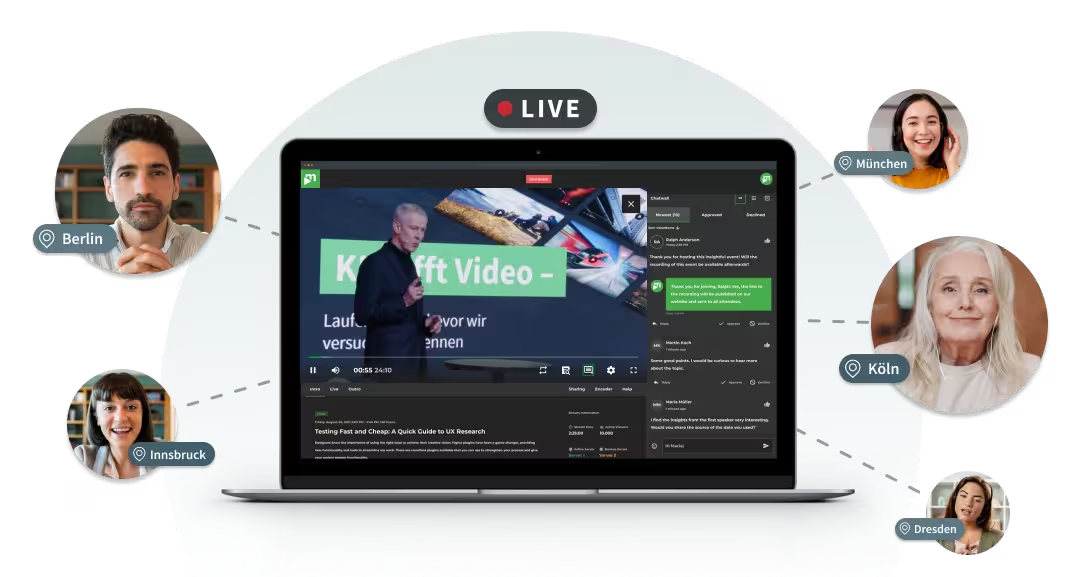
For a large corporate livestream, it is not enough for the platform to simply support high viewer numbers. What matters is whether it remains stable when thousands of employees tune in at the same time – across different locations, countries, networks and devices.
A scalable livestreaming platform should be able to reliably handle high traffic and efficiently deliver the stream to viewers. Technologies such as Content Delivery Networks (CDNs) distribute the stream, while Adaptive Bitrate Streaming automatically adjusts video quality to the available bandwidth. For international companies in particular, this helps provide a stable viewing experience even under varying network conditions.
Internal livestreams present another challenge: When thousands of employees access a stream simultaneously via the corporate network, this can put significant strain on the internal infrastructure. Depending on the company structure and size of the event, it is therefore important to understand what options are available to optimize network load.
So the key question is not only: How many concurrent viewers can the platform support? But also: How reliably can the stream reach them under real-world conditions?
Questions to ask your livestreaming provider:
- How many concurrent viewers can the platform reliably support?
- How is the stream delivered when viewer numbers are high and audiences are distributed internationally?
- Does the platform support Adaptive Bitrate Streaming?
- What options are available to reduce the load on the corporate network during large internal livestreams?
- How is streaming performance monitored during a live event?
4. Reliability: What happens when something goes wrong?
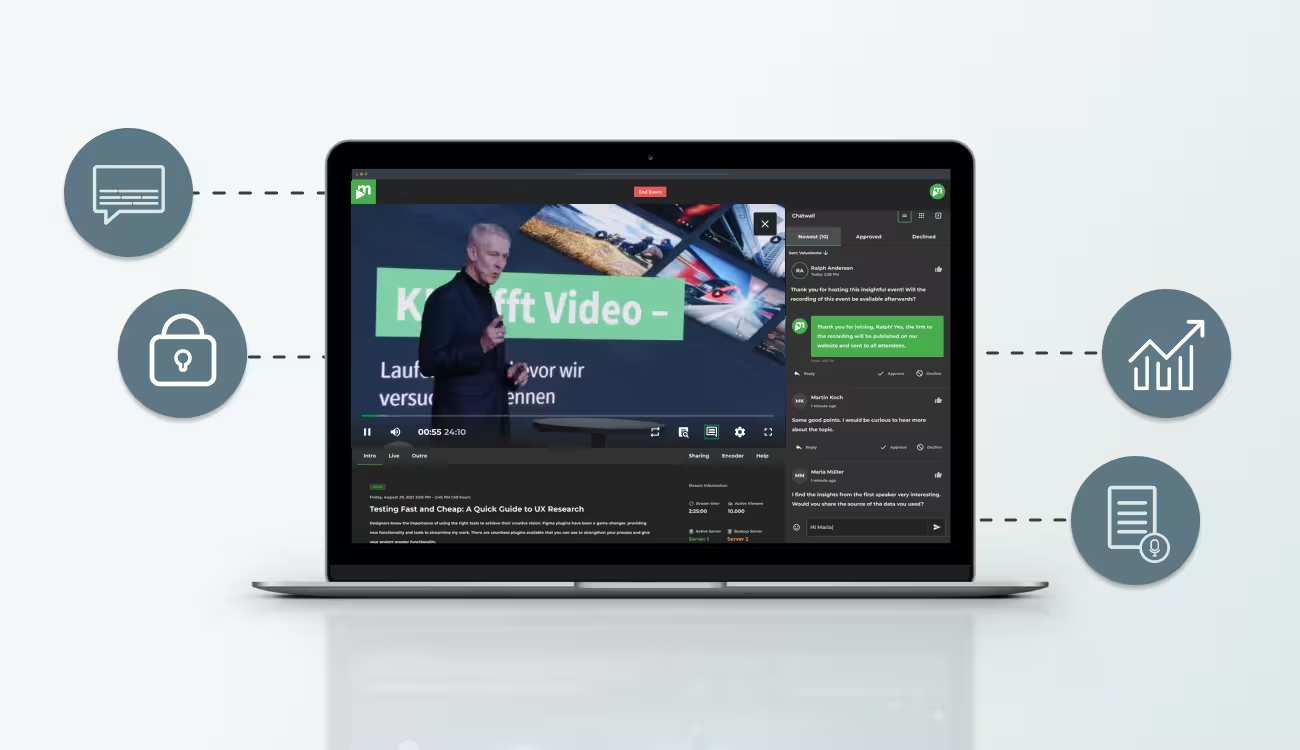
With a recorded video, a technical issue can be fixed before anyone sees it. With a livestream, that is not an option. When the CEO is speaking to several thousand employees or important company information is being communicated live, the broadcast needs to work – even when unexpected problems occur.
That is why an enterprise livestreaming platform needs to offer more than stable delivery under normal conditions. Redundant systems, backup solutions, continuous monitoring and clearly defined processes for handling technical issues help reduce the risk of outages and enable a fast response when problems arise. Service Level Agreements (SLAs) can also provide clarity on the availability and support a provider contractually guarantees.
Support is just as important. Especially for business-critical events, it should be clear who can be reached in an emergency and how quickly assistance is available. Depending on internal resources, it may also make sense to go beyond using the platform itself and involve technical experts in preparing and running the livestream.
Questions to ask your livestreaming provider:
- What redundancies and backup solutions are available for critical livestreams?
- How are streams technically monitored during a live event?
- What level of availability is guaranteed in the SLA?
- What technical support is available before and during the event?
- Can the provider also support the technical planning and delivery of the livestream if needed?
5. User Experience: How easy is livestreaming for viewers and teams?
A corporate livestream can only achieve its purpose if people can participate without unnecessary barriers. Lengthy registration processes, additional software or issues with certain devices can make access unnecessarily difficult, especially for large internal events designed to reach as many employees as possible.
A good livestreaming platform should therefore provide easy access across different devices and browsers and automatically adapt playback to varying network conditions. Integration with existing communication channels such as intranets or corporate websites also plays an important role. At the same time, the viewing experience should be customizable to match the company’s brand, for example through a branded or white-label player.
But User Experience is not just about viewers. The platform should also be easy to use for Corporate Communications and event teams. Creating livestreams, configuring access rights, running tests, embedding content and analyzing results should be possible without unnecessary technical complexity. The fewer operational hurdles there are, the easier it becomes to make livestreaming a regular part of corporate communications.
Questions to ask your livestreaming provider:
- Can viewers access the livestream without installing additional software?
- Does the stream work reliably across different browsers and devices?
- Can the player be integrated into existing websites, intranets or other communication channels?
- Can the streaming experience be customized to match the corporate design?
- How easily can communications teams create, configure and manage livestreams themselves?
6. Accessibility and multilingual support: Can everyone participate?
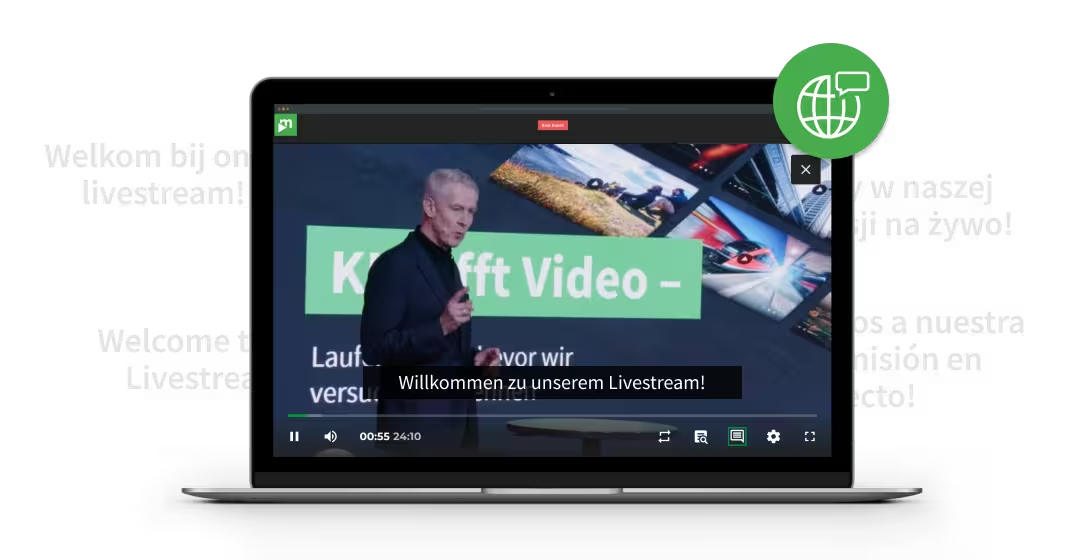
Corporate communications should reach as many employees as possible – regardless of hearing ability, language or location. For international companies in particular, accessibility and multilingual support are therefore important requirements for a modern livestreaming platform.
Live captions make spoken content accessible to people who are deaf or hard of hearing and are also useful in situations where viewers cannot follow the stream with sound. Companies should therefore assess what options a platform offers for live captions and accessible streaming, as well as which relevant accessibility standards it supports.
AI-generated live captions offer an additional benefit: They can automatically transcribe content during the broadcast and translate it into different languages. For example, a global town hall held in English can simultaneously be made more accessible to employees in Germany, France or Spain. Especially for recurring international events, this can be a scalable alternative or complement to traditional live interpreting and significantly reduce organizational effort and costs.
It is not only the availability of automated captions that matters, but also their quality. Technical terms, product names and company-specific vocabulary can quickly pose challenges for generic speech recognition. For companies, it can therefore be important to check whether specific terminology can be added in advance to improve caption accuracy.
Questions to ask your livestreaming provider:
- Does the platform support live captions and accessible streaming?
- Can captions be generated automatically using AI during a livestream?
- Which languages can live captions be translated into?
- Can company-specific terms, brand names and technical terminology be added to improve recognition?
- Which accessibility standards does the player support?
7. Analytics and integrations: What happens around the livestream?
A livestream does not automatically end when the broadcast is over. For communications teams, it is just as important to understand who they reached, how the content was used and what happens to it afterwards.
An enterprise livestreaming platform should therefore provide relevant analytics – for example, viewer numbers, watch time, usage across different devices or how participation changed over the course of the event. This allows teams not only to assess the success of individual events, but also to gain insights for future formats. Of course, the same data protection and access control requirements apply here as they do to the livestream itself.
At the same time, livestreaming should not be an isolated system within the communications landscape. Integrations, APIs and flexible embedding options make it possible to deliver streams through the intranet, corporate website or other existing platforms and integrate them into established processes.
The content should also remain useful after the event. A recording can be made available directly as an on-demand video for employees who were unable to attend live. This turns a one-time live event into content that continues to deliver value beyond the event itself.
Questions to ask your livestreaming provider:
- What analytics are available for live and on-demand viewing?
- What viewer and usage data is collected?
- Can livestreams be integrated into existing websites, intranets and enterprise systems?
- Does the platform offer APIs or other interfaces for existing workflows?
- Can recordings be easily repurposed as on-demand content after the event?
The enterprise livestreaming checklist: 7 questions to ask your livestreaming provider
Security, compliance, scalability and accessibility can quickly become highly technical topics. But for an initial evaluation, much of it can be narrowed down to seven key questions. Use this checklist to compare livestreaming platforms or define the requirements for your next enterprise livestreaming project.
| Area | The key question |
|---|---|
| Security | Can we control exactly who can access which livestreams? |
| Compliance & data protection | Do we know where our data is processed, who can access it and whether our data protection requirements are met? |
| Scalability | Can the platform reliably support our expected viewer numbers, even with high levels of concurrent usage? |
| Reliability | What redundancies, backups and support processes are in place if something goes wrong during an important livestream? |
| User Experience | Can viewers participate easily and can our teams manage livestreams without unnecessary technical complexity? |
| Accessibility & multilingual support | Can all relevant audiences follow the livestream, including with live captions and in different languages? |
| Analytics & integrations | Can we analyze usage and integrate livestreaming effectively into our existing systems and content processes? |
Not every company will answer these questions in the same way. A public press event has different requirements than an internal town hall involving confidential information or a global all-hands meeting with several thousand employees. The goal is therefore not to tick as many boxes as possible on a feature list. The platform should fit your specific use cases, IT infrastructure and requirements for security, data protection and communications.
Conclusion: Enterprise-ready means more than “the stream works”
A professional livestreaming platform for enterprises needs to do much more today than simply deliver video reliably. Security, compliance, scalability, reliability, User Experience, accessibility and integrations all play a role in ensuring that livestreaming works for large, international or sensitive corporate events.
Which requirements matter most depends on the specific use case. For a global town hall, scalability, multilingual live captions and accessibility may be the top priorities. For a confidential leadership update, on the other hand, access control, data protection and security may be critical.
When choosing a livestreaming platform or reassessing an existing solution, companies should therefore look beyond feature lists. Use the seven questions in this checklist to define together with IT, data protection and Corporate Communications what your platform actually needs to deliver, and to ask potential livestreaming providers the right questions.
.avif)

Enterprise livestreaming for demanding corporate communications

.avif)
Enterprise livestreaming for demanding corporate communications
FAQ:
What should a livestreaming platform for enterprises be able to do?
A livestreaming platform for enterprises should provide secure access controls, data protection and compliance, high scalability, reliable delivery and an easy User Experience. For international companies, accessible and multilingual livestreaming is also important. Analytics, integrations and the ability to repurpose recordings as on-demand content make it easier to integrate livestreaming into existing communication processes.
What should companies look for when choosing a livestreaming provider?
When choosing a livestreaming provider, companies should pay particular attention to security, data protection, hosting, scalability, reliability, support, User Experience and accessibility. It is also important to consider whether the livestreaming platform can be integrated into existing enterprise systems. The specific requirements should always reflect the intended use case as well as the size and structure of the organization.
How secure is livestreaming for enterprises?
Enterprise livestreaming can be secured through a range of measures. These include Single Sign-On (SSO), role-based access controls, as well as token-, IP-, geo- or referrer-based access restrictions. For sensitive internal livestreams, companies should also check where data is processed, which security standards the livestreaming provider meets and how personal data is protected.
How can companies livestream to thousands of employees?
Large livestreams require a scalable infrastructure that can reliably serve many concurrent viewers. Content Delivery Networks (CDNs) distribute the stream, while Adaptive Bitrate Streaming adjusts the quality to different network conditions. For large internal events, companies should also consider how the load on the corporate network can be reduced.
Can livestreams be automatically captioned and translated?
Yes. Modern livestreaming platforms can use AI to automatically transcribe spoken content during a livestream and provide captions in different languages. This improves accessibility and makes international corporate events accessible to more employees. Depending on the event, AI-powered live captions can also provide a scalable alternative or complement to live interpreting.
Our Speakers
Enterprise livestreaming comes with different requirements
A town hall with several thousand employees, a confidential leadership update or an international corporate event places very different demands on livestreaming than a public broadcast for an unrestricted audience. It is no longer just about reliably getting a video signal from A to B.
Anyone planning or managing livestreams in a large organization has to consider a wide range of requirements at the same time: Who should be able to access the stream? Where is data processed? Can the infrastructure handle high numbers of concurrent viewers? Can employees across different locations and devices participate without issues? Is the stream accessible? And what happens if something does go wrong during an important live event?
Choosing a livestreaming platform should therefore go beyond standard streaming functionality. Security, compliance, scalability and reliability are just as important as a good user experience for both viewers and the teams managing the stream.
The following enterprise livestreaming checklist covers seven key areas to consider when selecting or evaluating a livestreaming platform. For each one, you will also find specific questions to ask potential livestreaming providers.
1. Security: Who can access the livestream?
Corporate livestreams are not necessarily intended for the public. Town halls, leadership updates and internal events often involve information that is meant exclusively for employees or even specific groups within the organization. This makes it essential to have precise control over who can access a livestream.
An enterprise livestreaming platform should offer different ways to secure streams and manage access. These can include Single Sign-On (SSO), role-based access controls, as well as token-, IP-, geo- or referrer-based restrictions. The right measures depend on the specific use case: An internal all-hands meeting has different access requirements than a public press event or a confidential leadership event.
Security should not come at the expense of the user experience. Especially for large internal events, access should be as seamless as possible for authorized viewers and ideally integrate with existing identity and enterprise systems.
Questions to ask your livestreaming provider:
- What options are available to restrict access to a livestream?
- Does the platform support SSO and existing identity systems?
- Can different audience groups be assigned different access rights?
- What additional security measures are available for particularly sensitive streams?
2. Compliance and data protection: Where is your data stored?
When a new livestreaming platform is introduced in an organization, Corporate Communications is often joined at the table by IT, data protection and procurement. At that point, it is no longer just about streaming quality and features, but also questions such as: Where is data stored and processed? What personal data is collected? And which companies or subprocessors have access to it?
With enterprise livestreaming, personal information may be processed in addition to the video data itself – including registration data, IP addresses, as well as viewer usage and analytics data. Companies should therefore carefully assess how a livestreaming platform provider handles this data and what options are available to ensure data protection compliance.
For companies in Germany and the EU, GDPR compliance, hosting and data processing within the EU, as well as transparent data processing agreements, are particularly relevant. Established security standards and certifications such as ISO 27001 can also play an important role when evaluating a provider.
It is important not to rely solely on claims such as “GDPR-compliant” or “enterprise security.” A suitable provider should be able to clearly explain where data is processed, what data is collected and which technical and organizational measures are in place to protect it.
Questions to ask your livestreaming provider:
- Where are video, user and analytics data stored and processed?
- What personal data is collected during a livestream?
- Is fully EU-based data processing possible?
- Which subprocessors are involved in processing the data?
- Is a Data Processing Agreement (DPA) available, and does the provider hold relevant certifications such as ISO 27001?
3. Scalability: What happens when thousands of viewers join at once?
For a large corporate livestream, it is not enough for the platform to simply support high viewer numbers. What matters is whether it remains stable when thousands of employees tune in at the same time – across different locations, countries, networks and devices.
A scalable livestreaming platform should be able to reliably handle high traffic and efficiently deliver the stream to viewers. Technologies such as Content Delivery Networks (CDNs) distribute the stream, while Adaptive Bitrate Streaming automatically adjusts video quality to the available bandwidth. For international companies in particular, this helps provide a stable viewing experience even under varying network conditions.
Internal livestreams present another challenge: When thousands of employees access a stream simultaneously via the corporate network, this can put significant strain on the internal infrastructure. Depending on the company structure and size of the event, it is therefore important to understand what options are available to optimize network load.
So the key question is not only: How many concurrent viewers can the platform support? But also: How reliably can the stream reach them under real-world conditions?
Questions to ask your livestreaming provider:
- How many concurrent viewers can the platform reliably support?
- How is the stream delivered when viewer numbers are high and audiences are distributed internationally?
- Does the platform support Adaptive Bitrate Streaming?
- What options are available to reduce the load on the corporate network during large internal livestreams?
- How is streaming performance monitored during a live event?
4. Reliability: What happens when something goes wrong?
With a recorded video, a technical issue can be fixed before anyone sees it. With a livestream, that is not an option. When the CEO is speaking to several thousand employees or important company information is being communicated live, the broadcast needs to work – even when unexpected problems occur.
That is why an enterprise livestreaming platform needs to offer more than stable delivery under normal conditions. Redundant systems, backup solutions, continuous monitoring and clearly defined processes for handling technical issues help reduce the risk of outages and enable a fast response when problems arise. Service Level Agreements (SLAs) can also provide clarity on the availability and support a provider contractually guarantees.
Support is just as important. Especially for business-critical events, it should be clear who can be reached in an emergency and how quickly assistance is available. Depending on internal resources, it may also make sense to go beyond using the platform itself and involve technical experts in preparing and running the livestream.
Questions to ask your livestreaming provider:
- What redundancies and backup solutions are available for critical livestreams?
- How are streams technically monitored during a live event?
- What level of availability is guaranteed in the SLA?
- What technical support is available before and during the event?
- Can the provider also support the technical planning and delivery of the livestream if needed?
5. User Experience: How easy is livestreaming for viewers and teams?
A corporate livestream can only achieve its purpose if people can participate without unnecessary barriers. Lengthy registration processes, additional software or issues with certain devices can make access unnecessarily difficult, especially for large internal events designed to reach as many employees as possible.
A good livestreaming platform should therefore provide easy access across different devices and browsers and automatically adapt playback to varying network conditions. Integration with existing communication channels such as intranets or corporate websites also plays an important role. At the same time, the viewing experience should be customizable to match the company’s brand, for example through a branded or white-label player.
But User Experience is not just about viewers. The platform should also be easy to use for Corporate Communications and event teams. Creating livestreams, configuring access rights, running tests, embedding content and analyzing results should be possible without unnecessary technical complexity. The fewer operational hurdles there are, the easier it becomes to make livestreaming a regular part of corporate communications.
Questions to ask your livestreaming provider:
- Can viewers access the livestream without installing additional software?
- Does the stream work reliably across different browsers and devices?
- Can the player be integrated into existing websites, intranets or other communication channels?
- Can the streaming experience be customized to match the corporate design?
- How easily can communications teams create, configure and manage livestreams themselves?
6. Accessibility and multilingual support: Can everyone participate?
Corporate communications should reach as many employees as possible – regardless of hearing ability, language or location. For international companies in particular, accessibility and multilingual support are therefore important requirements for a modern livestreaming platform.
Live captions make spoken content accessible to people who are deaf or hard of hearing and are also useful in situations where viewers cannot follow the stream with sound. Companies should therefore assess what options a platform offers for live captions and accessible streaming, as well as which relevant accessibility standards it supports.
AI-generated live captions offer an additional benefit: They can automatically transcribe content during the broadcast and translate it into different languages. For example, a global town hall held in English can simultaneously be made more accessible to employees in Germany, France or Spain. Especially for recurring international events, this can be a scalable alternative or complement to traditional live interpreting and significantly reduce organizational effort and costs.
It is not only the availability of automated captions that matters, but also their quality. Technical terms, product names and company-specific vocabulary can quickly pose challenges for generic speech recognition. For companies, it can therefore be important to check whether specific terminology can be added in advance to improve caption accuracy.
Questions to ask your livestreaming provider:
- Does the platform support live captions and accessible streaming?
- Can captions be generated automatically using AI during a livestream?
- Which languages can live captions be translated into?
- Can company-specific terms, brand names and technical terminology be added to improve recognition?
- Which accessibility standards does the player support?
7. Analytics and integrations: What happens around the livestream?
A livestream does not automatically end when the broadcast is over. For communications teams, it is just as important to understand who they reached, how the content was used and what happens to it afterwards.
An enterprise livestreaming platform should therefore provide relevant analytics – for example, viewer numbers, watch time, usage across different devices or how participation changed over the course of the event. This allows teams not only to assess the success of individual events, but also to gain insights for future formats. Of course, the same data protection and access control requirements apply here as they do to the livestream itself.
At the same time, livestreaming should not be an isolated system within the communications landscape. Integrations, APIs and flexible embedding options make it possible to deliver streams through the intranet, corporate website or other existing platforms and integrate them into established processes.
The content should also remain useful after the event. A recording can be made available directly as an on-demand video for employees who were unable to attend live. This turns a one-time live event into content that continues to deliver value beyond the event itself.
Questions to ask your livestreaming provider:
- What analytics are available for live and on-demand viewing?
- What viewer and usage data is collected?
- Can livestreams be integrated into existing websites, intranets and enterprise systems?
- Does the platform offer APIs or other interfaces for existing workflows?
- Can recordings be easily repurposed as on-demand content after the event?
The enterprise livestreaming checklist: 7 questions to ask your livestreaming provider
Security, compliance, scalability and accessibility can quickly become highly technical topics. But for an initial evaluation, much of it can be narrowed down to seven key questions. Use this checklist to compare livestreaming platforms or define the requirements for your next enterprise livestreaming project.
| Area | The key question |
|---|---|
| Security | Can we control exactly who can access which livestreams? |
| Compliance & data protection | Do we know where our data is processed, who can access it and whether our data protection requirements are met? |
| Scalability | Can the platform reliably support our expected viewer numbers, even with high levels of concurrent usage? |
| Reliability | What redundancies, backups and support processes are in place if something goes wrong during an important livestream? |
| User Experience | Can viewers participate easily and can our teams manage livestreams without unnecessary technical complexity? |
| Accessibility & multilingual support | Can all relevant audiences follow the livestream, including with live captions and in different languages? |
| Analytics & integrations | Can we analyze usage and integrate livestreaming effectively into our existing systems and content processes? |
Not every company will answer these questions in the same way. A public press event has different requirements than an internal town hall involving confidential information or a global all-hands meeting with several thousand employees. The goal is therefore not to tick as many boxes as possible on a feature list. The platform should fit your specific use cases, IT infrastructure and requirements for security, data protection and communications.
Conclusion: Enterprise-ready means more than “the stream works”
A professional livestreaming platform for enterprises needs to do much more today than simply deliver video reliably. Security, compliance, scalability, reliability, User Experience, accessibility and integrations all play a role in ensuring that livestreaming works for large, international or sensitive corporate events.
Which requirements matter most depends on the specific use case. For a global town hall, scalability, multilingual live captions and accessibility may be the top priorities. For a confidential leadership update, on the other hand, access control, data protection and security may be critical.
When choosing a livestreaming platform or reassessing an existing solution, companies should therefore look beyond feature lists. Use the seven questions in this checklist to define together with IT, data protection and Corporate Communications what your platform actually needs to deliver, and to ask potential livestreaming providers the right questions.
Enterprise livestreaming for demanding corporate communications

Enterprise livestreaming for demanding corporate communications
FAQ:
What should a livestreaming platform for enterprises be able to do?
A livestreaming platform for enterprises should provide secure access controls, data protection and compliance, high scalability, reliable delivery and an easy User Experience. For international companies, accessible and multilingual livestreaming is also important. Analytics, integrations and the ability to repurpose recordings as on-demand content make it easier to integrate livestreaming into existing communication processes.
What should companies look for when choosing a livestreaming provider?
When choosing a livestreaming provider, companies should pay particular attention to security, data protection, hosting, scalability, reliability, support, User Experience and accessibility. It is also important to consider whether the livestreaming platform can be integrated into existing enterprise systems. The specific requirements should always reflect the intended use case as well as the size and structure of the organization.
How secure is livestreaming for enterprises?
Enterprise livestreaming can be secured through a range of measures. These include Single Sign-On (SSO), role-based access controls, as well as token-, IP-, geo- or referrer-based access restrictions. For sensitive internal livestreams, companies should also check where data is processed, which security standards the livestreaming provider meets and how personal data is protected.
How can companies livestream to thousands of employees?
Large livestreams require a scalable infrastructure that can reliably serve many concurrent viewers. Content Delivery Networks (CDNs) distribute the stream, while Adaptive Bitrate Streaming adjusts the quality to different network conditions. For large internal events, companies should also consider how the load on the corporate network can be reduced.
Can livestreams be automatically captioned and translated?
Yes. Modern livestreaming platforms can use AI to automatically transcribe spoken content during a livestream and provide captions in different languages. This improves accessibility and makes international corporate events accessible to more employees. Depending on the event, AI-powered live captions can also provide a scalable alternative or complement to live interpreting.
Our Speakers
Voices from our customers





.avif)



.avif "Corporate Communications 2027: Agentic AI Webinar")