


The hidden costs of poor video infrastructure in large organizations

Communication that makes an impact
The hidden costs of poor video infrastructure in large organizations
Livestreams for executive communication, global town halls, change updates, training videos, or ESG messages. Video is now one of the most important channels in corporate communications. And yet, in many organizations, the underlying infrastructure is still treated as a side project: historically grown, decentralized, and distributed across multiple tools and responsibilities.
The result? Not just higher licensing costs.
But also:
- inefficient processes
- duplicated work
- fragmented data
- shadow IT
- a lack of strategic oversight
The most significant costs of poor video infrastructure never appear in a budget report. They arise in lost time, internal friction, and missed strategic opportunities. In large organizations with complex communication structures, this quickly becomes a structural issue.
Video is no longer a one-off initiative, but a strategic communication channel. Whether it can scale efficiently or becomes trapped in operational complexity depends on the underlying infrastructure.
In this article, we examine:
- which visible and hidden costs are created by fragmented video structures
- why silos and shadow IT significantly undermine efficiency and
- how to recognize whether your video infrastructure is strategically future-proof
Because in the end, this isn’t about tools. It’s about architecture.
1. Why we need to talk about costs
In many organizations, video communication is primarily discussed from a creative or technical perspective: production quality, reach, format variety, streaming stability. Rarely, however, is the underlying infrastructure viewed as an economic factor. Yet it is precisely this infrastructure that determines efficiency and ROI.
Because the costs of video communication do not arise solely from:
- production efforts
- external service providers
- licenses for individual tools
They arise primarily from structural inefficiency.
In large organizations with multiple locations, departments, and responsibilities, small points of friction quickly add up to a significant cost factor. An additional coordination meeting here, a duplicate upload there, manual post-production that could have been automated.
The problem: These costs are rarely visible as “video costs.” They are hidden in time, coordination, and operational effort.
They are distributed across:
- personnel costs
- time expenditure
- delays in internal communication
- security and compliance risks
And that is exactly why they often go unnoticed. From a business perspective, however, one principle applies: Any infrastructure that is not standardized and scalable generates additional operational costs.
For Corporate Communications, this means in practical terms: If livestreams, town halls, or internal video formats have to be reorganized from scratch each time, the issue rarely lies with the format itself, but with the lack of a structural foundation.
Video is a recurring, strategic communication channel — and therefore requires robust structures. As long as video relies on historically grown tool landscapes, individual workarounds, and decentralized responsibilities, costs will increase exponentially as usage expands.
Before discussing consolidation or platform strategies, we need to ask a more fundamental question: What structural costs does your current video infrastructure create — and who is actually bearing them?
2. What does “poor video infrastructure” actually mean?
The term “video infrastructure” is often equated with individual tools or platforms. But infrastructure is more than software.
Video infrastructure encompasses all the technical, organizational, and process-related conditions that enable video communication within an organization.
This includes, among other things:
- the streaming and hosting solutions in use
- role and permission models
- governance structures
- workflows for production, publishing, and archiving
- analytics and reporting
- integrations into existing systems
Poor video infrastructure does not necessarily exist when individual tools are inadequate. It primarily arises when these elements are not properly integrated and aligned.
Typical characteristics of a fragmented structure include:
- multiple video tools used in parallel across different departments
- no central responsibility or clear ownership
- manual, non-standardized processes
- a lack of transparency regarding usage and performance
- inconsistent security and compliance standards
The result is not a strategic infrastructure, but a historically grown collection of tools. And this is precisely where the problem begins.
A collection of tools may fulfill individual requirements. An infrastructure, however, must be scalable, manageable, and consistent across the entire organization.
For Corporate Communications, this means: If each department uses its own solutions, defines its own processes, and measures its own KPIs, no shared communication architecture emerges. Instead, complexity increases. This complexity becomes the breeding ground for efficiency losses, silos, and shadow IT — precisely the factors we will analyze in the following sections.
In summary: Poor video infrastructure is not about missing features. It is a structural weakness in the interaction between technology, processes, and accountability.
Next, we will examine which of these structural weaknesses are already visible — and which costs can be directly quantified.
3. Visible costs: What organizations can already measure
Some of the costs associated with poor video infrastructure are obvious. These expenses appear in budgets, contracts, and invoices. They are measurable — but often not recognized as a structural issue.
3.1 Licensing and tool costs
In many large organizations, the following coexist in parallel:
- a webinar solution for marketing
- a streaming platform for internal events
- a separate video hosting tool
- additional collaboration or upload tools
- external service providers for specific formats
What initially appears flexible quickly turns into a complex and opaque licensing landscape.
Organizations often do not know exactly:
- how many video tools are actually in use
- which departments have independently procured licenses
- which functionalities overlap
The result is duplicate costs and inefficient contract structures. And even if individual tools appear cost-effective in isolation, operating them in parallel creates structural cost inflation.
3.2 Additional operational costs caused by manual processes
Beyond licensing fees, direct operational costs arise.
Typical examples include:
- multiple uploads of the same video into different systems
- manual adjustment of metadata
- separate approval workflows for each platform
- individual event setups without reusable templates
- manual post-production and distribution of livestreams
Each of these steps consumes time. And time is a budget factor. In large organizations with regular town halls, leadership updates, or global livestream formats, these manual efforts accumulate significantly. What may seem marginal as a single task becomes a persistent efficiency loss when repeated over time.
3.3 External dependencies
A lack of standardization often leads to recurring tasks being outsourced:
- event setup
- streaming management
- post-production
- platform administration
Not because internal expertise is lacking, but because no scalable structure exists. This dependency not only increases costs but also reduces flexibility and responsiveness.
Up to this point, we are discussing costs that can at least partially be quantified. However, these visible expenses represent only part of the reality. The far greater impact occurs where efficiency declines, responsibilities blur, and organizational silos expand. This is where hidden costs begin — and where video infrastructure becomes a strategic issue.
4. Hidden costs: Where poor video infrastructure becomes truly expensive
The most significant financial impact of fragmented video structures does not appear in any licensing overview. It emerges in day-to-day operations — in coordination meetings, manual workarounds, and a lack of transparency. For Corporate Communications in particular, these structural friction points are especially critical, because video is now a recurring, strategic channel.
4.1 Efficiency loss: When processes consume time instead of creating impact
In many organizations, each livestream is organized from scratch.
- new event setup
- individual landing page
- separate invitation tools
- manual participant management
- individual post-production and distribution
What is missing are standardized workflows and reusable structures. As a result, teams spend a significant portion of their time on operational coordination rather than strategic content.
A typical scenario:
A global town hall livestream
→ multiple departments involved
→ different tools
→ numerous coordination loops
→ manual post-production
→ separate publishing in additional systems
Each individual step is understandable. Taken together, however, they create structural efficiency loss. From a business perspective, one principle applies: Non-standardized processes increase the cost per format with every repetition. For Corporate Communications, this means that instead of generating economies of scale, each repetition becomes a standalone project.
Practical example: What does a fragmented livestream process cost per year?
- 2 internal livestreams per month (e.g., town hall, leadership update)
- Additional effort per livestream caused by:
- manual workflows
- parallel tools
- additional coordination loops
- lack of standardization
- → average of 12 additional internal working hours
The key takeaway: Fragmentation does not only create complexity — it generates predictable, recurring additional costs.
Organizations that want to scale video strategically should therefore not only talk about production budgets, but about process costs and structural efficiency.
4.2 Organizational silos: When video is not managed enterprise-wide
Video today affects multiple areas:
- Internal Communications
- HR & Learning
- Executive Communication
- IT
- Marketing
Without central governance, parallel structures emerge. Each department defines its own processes, its own KPIs, its own tools.
The consequences:
- no unified data foundation
- no company-wide overview of content and performance
- no strategic learning process
- no scalability across locations
Video is implemented operationally, but not managed strategically. And without strategic steering, communicative ROI remains limited. Fragmentation does not only undermine efficiency — it also undermines insight.
4.3 Shadow IT: When structural gaps create risk
Where centralized infrastructure is lacking, workarounds emerge.
Employees resort to:
- public streaming platforms
- private accounts
- unauthorized tools
- independently procured software solutions
This form of shadow IT rarely stems from intentional rule-breaking — but from pragmatic necessity.
However, it carries risks:
- unclear data processing
- lack of GDPR compliance
- insufficient access control
- limited auditability
For Corporate Communications, this also represents a reputational risk. What appears flexible in the short term can undermine trust and security in the long term. The hidden costs of poor video infrastructure are therefore not purely financial in nature.
They affect:
- Efficiency
- Transparency
- Control
- Security
- scalability
And this is where it becomes clear: Video infrastructure is not a minor technical detail. It is a management decision.
5. Opportunity costs: What your communication fails to achieve
Beyond visible and hidden additional costs, there is a third, often underestimated factor: opportunity costs.
In other words: What could your Corporate Communications achieve if these structural barriers did not exist? Because inefficient infrastructure does not only create effort — it limits potential.
5.1 Lack of scalability for strategic formats
Many organizations invest in high-quality standalone events:
- global town halls
- CEO livestreams
- virtual leadership meetings
- internal campaign formats
But without standardized infrastructure, these formats remain isolated events.
What is missing:
- a scalable series structure
- reusable templates
- automated distribution
- consistent performance measurement
Instead of economies of scale, repetition creates additional effort. Scalability is not a creative challenge — it is an infrastructure issue.
5.2 Limited data foundation for strategic management
Modern Corporate Communications is data-driven. Reach, engagement, watch time, international usage — all of these metrics provide valuable insights for optimizing formats and messages.
Fragmented video environments, however, lead to:
- distributed analytics
- inconsistent measurement methods
- lack of comparability
- limited transparency at management level
- suboptimal use of content
Without a consolidated data foundation, video remains an operational channel rather than a strategic management instrument. This has a direct impact on the ROI of communication.
5.3 Limited capacity for innovation
A historically grown collection of tools is difficult to integrate.
New requirements such as:
- global hybrid formats
- automated captioning and transcription
- AI-driven analysis
- personalized video distribution
- integration into intranet or HR systems
can only be implemented to a limited extent or with significant additional effort. Infrastructure therefore directly determines the speed of innovation. And in Corporate Communications, innovation speed has long become a competitive factor — particularly during periods of transformation.
5.4 Loss of strategic relevance
When video communication is primarily organized operationally, it remains reactive rather than proactive.
Corporate Communications then focuses on:
- coordination instead of strategy
- process management instead of impact
- structural challenges instead of development
The result is not only reduced efficiency, but also a weakened strategic role within the organization. Infrastructure therefore indirectly determines the influence of Corporate Communications.
6. How to recognize that your video infrastructure is not future-ready
Not every historically grown structure is automatically problematic. It becomes critical when video plays a strategic role within the organization, while the underlying infrastructure remains operationally organized.
The following questions help with a realistic assessment:
6.1 Structure & governance
- Is there a clearly defined, central ownership of video communication?
- Are role and permission models standardized across the organization?
- Do binding standards exist for livestreams and video formats?
If video is organized differently in every department, the foundation for scalability is missing.
6.2 Processes & efficiency
- Does every livestream need to be set up from scratch?
- Are contents distributed or uploaded manually multiple times?
- Are reusable templates and automated workflows in place?
Repetition should reduce costs, not increase them. If processes repeat with every iteration instead of becoming more efficient, a structural issue exists.
6.3 Transparency & control
- Do you have a consolidated overview of reach, engagement, and usage?
- Can you compare performance across the organization?
- Are video KPIs transparent at management level?
Without a consolidated data foundation, video remains operational rather than strategically manageable.
6.4 Security & compliance
- Are all video solutions documented as GDPR-compliant?
- Are security standards consistent across the organization?
- Do you know which tools are being used outside centralized IT structures?
A lack of transparency does not only increase complexity — it also increases risk.
A simple indicator
If a single livestream requires multiple tools, multiple coordination loops, and multiple manual steps, your infrastructure is most likely not scalable. The ability to operate video formats in a repeatable and reliable way is the decisive factor for economically sustainable video communication in large organizations. Future-ready infrastructure reduces complexity — not just costs.
7. What modern video infrastructure does differently
If poor infrastructure is primarily characterized by fragmentation, manual processes, and a lack of governance, the question becomes: What does the alternative look like?
Modern video infrastructure is not simply a new software solution. It is a structural concept. Its goal is to make video communication manageable, scalable, and efficient across the entire organization.
7.1 Central governance instead of decentralized individual solutions
Future-ready structures are defined by clear accountability:
- a defined ownership
- organization-wide standards
- consistent role and permission models
- transparent processes
This does not mean that departments lose flexibility. It means that video is organized as a strategic channel rather than an isolated project. Governance creates clarity. Clarity creates efficiency.
7.2 Standardized and automated workflows
Modern infrastructure reduces manual steps.
This includes:
- reusable livestream templates
- automated publishing processes
- integrated post-production
- centralized media libraries
- systematic archiving
Repetition then leads to efficiency gains rather than additional effort. Scalability becomes predictable.
7.3 Consolidated analytics and strategic management
Modern infrastructure enables:
- central dashboards
- organization-wide KPI transparency
- comparable performance data
- data-driven optimization of formats
Video evolves from an operational channel into a strategic management instrument. This also changes the position of Corporate Communications within the organization.
7.4 Security and compliance as a standard — not an add-on
Enterprise structures integrate:
- GDPR-compliant data processing
- clearly documented processes
- role-based access control
- auditability
Security becomes part of the architecture — not an afterthought.
Fragmented vs. strategic: a structural difference
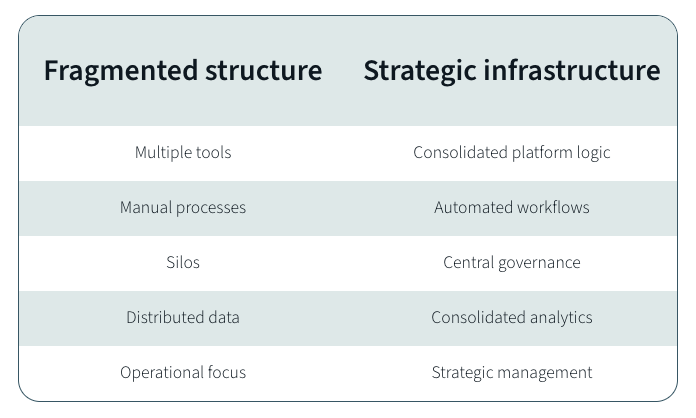
The decisive difference does not lie in individual features. It lies in the ability to scale video communication across the organization without increasing complexity. Modern video infrastructure does not only reduce costs. It creates structural ROI.
What does that mean in practical terms for the ROI of your communication?
- Lower operational costs per format through standardized processes
- Greater reach with the same level of resources
- Faster implementation of strategic formats
- Improved data foundation for continuous optimization
- Reduced security and compliance risks
ROI is not created by reach alone. It results from a better ratio between resources invested and impact achieved. A structured video infrastructure improves exactly that ratio — sustainably and at scale.
8. Conclusion: Infrastructure is a strategic decision
Video communication has become business-critical in large organizations. The real costs do not arise solely from production or licensing, but from structural inefficiency.
Fragmented processes, missing standards, and unclear responsibilities directly impact:
- Budget
- Speed
- Transparency
- Strategic steering capability
As video usage increases, these effects intensify. The decisive question is therefore not whether video is important, but whether your organization has created the structural foundation to operate video communication efficiently and at scale. Modern video infrastructure reduces operational friction, increases transparency, and improves the ratio between effort and impact.
Anyone who understands video as a strategic channel should not only optimize content — but also the underlying structure.
Next step
If you would like to understand how efficient your current video infrastructure truly is — and where structural optimization potential exists — a structured assessment is the logical next step.
Speak with our experts about a strategic evaluation of your existing setup and how to sustainably improve efficiency, governance, and scalability.
.avif)


.avif)
Our Speakers
Livestreams for executive communication, global town halls, change updates, training videos, or ESG messages. Video is now one of the most important channels in corporate communications. And yet, in many organizations, the underlying infrastructure is still treated as a side project: historically grown, decentralized, and distributed across multiple tools and responsibilities.
The result? Not just higher licensing costs.
But also:
- inefficient processes
- duplicated work
- fragmented data
- shadow IT
- a lack of strategic oversight
The most significant costs of poor video infrastructure never appear in a budget report. They arise in lost time, internal friction, and missed strategic opportunities. In large organizations with complex communication structures, this quickly becomes a structural issue.
Video is no longer a one-off initiative, but a strategic communication channel. Whether it can scale efficiently or becomes trapped in operational complexity depends on the underlying infrastructure.
In this article, we examine:
- which visible and hidden costs are created by fragmented video structures
- why silos and shadow IT significantly undermine efficiency and
- how to recognize whether your video infrastructure is strategically future-proof
Because in the end, this isn’t about tools. It’s about architecture.
1. Why we need to talk about costs
In many organizations, video communication is primarily discussed from a creative or technical perspective: production quality, reach, format variety, streaming stability. Rarely, however, is the underlying infrastructure viewed as an economic factor. Yet it is precisely this infrastructure that determines efficiency and ROI.
Because the costs of video communication do not arise solely from:
- production efforts
- external service providers
- licenses for individual tools
They arise primarily from structural inefficiency.
In large organizations with multiple locations, departments, and responsibilities, small points of friction quickly add up to a significant cost factor. An additional coordination meeting here, a duplicate upload there, manual post-production that could have been automated.
The problem: These costs are rarely visible as “video costs.” They are hidden in time, coordination, and operational effort.
They are distributed across:
- personnel costs
- time expenditure
- delays in internal communication
- security and compliance risks
And that is exactly why they often go unnoticed. From a business perspective, however, one principle applies: Any infrastructure that is not standardized and scalable generates additional operational costs.
For Corporate Communications, this means in practical terms: If livestreams, town halls, or internal video formats have to be reorganized from scratch each time, the issue rarely lies with the format itself, but with the lack of a structural foundation.
Video is a recurring, strategic communication channel — and therefore requires robust structures. As long as video relies on historically grown tool landscapes, individual workarounds, and decentralized responsibilities, costs will increase exponentially as usage expands.
Before discussing consolidation or platform strategies, we need to ask a more fundamental question: What structural costs does your current video infrastructure create — and who is actually bearing them?
2. What does “poor video infrastructure” actually mean?
The term “video infrastructure” is often equated with individual tools or platforms. But infrastructure is more than software.
Video infrastructure encompasses all the technical, organizational, and process-related conditions that enable video communication within an organization.
This includes, among other things:
- the streaming and hosting solutions in use
- role and permission models
- governance structures
- workflows for production, publishing, and archiving
- analytics and reporting
- integrations into existing systems
Poor video infrastructure does not necessarily exist when individual tools are inadequate. It primarily arises when these elements are not properly integrated and aligned.
Typical characteristics of a fragmented structure include:
- multiple video tools used in parallel across different departments
- no central responsibility or clear ownership
- manual, non-standardized processes
- a lack of transparency regarding usage and performance
- inconsistent security and compliance standards
The result is not a strategic infrastructure, but a historically grown collection of tools. And this is precisely where the problem begins.
A collection of tools may fulfill individual requirements. An infrastructure, however, must be scalable, manageable, and consistent across the entire organization.
For Corporate Communications, this means: If each department uses its own solutions, defines its own processes, and measures its own KPIs, no shared communication architecture emerges. Instead, complexity increases. This complexity becomes the breeding ground for efficiency losses, silos, and shadow IT — precisely the factors we will analyze in the following sections.
In summary: Poor video infrastructure is not about missing features. It is a structural weakness in the interaction between technology, processes, and accountability.
Next, we will examine which of these structural weaknesses are already visible — and which costs can be directly quantified.
3. Visible costs: What organizations can already measure
Some of the costs associated with poor video infrastructure are obvious. These expenses appear in budgets, contracts, and invoices. They are measurable — but often not recognized as a structural issue.
3.1 Licensing and tool costs
In many large organizations, the following coexist in parallel:
- a webinar solution for marketing
- a streaming platform for internal events
- a separate video hosting tool
- additional collaboration or upload tools
- external service providers for specific formats
What initially appears flexible quickly turns into a complex and opaque licensing landscape.
Organizations often do not know exactly:
- how many video tools are actually in use
- which departments have independently procured licenses
- which functionalities overlap
The result is duplicate costs and inefficient contract structures. And even if individual tools appear cost-effective in isolation, operating them in parallel creates structural cost inflation.
3.2 Additional operational costs caused by manual processes
Beyond licensing fees, direct operational costs arise.
Typical examples include:
- multiple uploads of the same video into different systems
- manual adjustment of metadata
- separate approval workflows for each platform
- individual event setups without reusable templates
- manual post-production and distribution of livestreams
Each of these steps consumes time. And time is a budget factor. In large organizations with regular town halls, leadership updates, or global livestream formats, these manual efforts accumulate significantly. What may seem marginal as a single task becomes a persistent efficiency loss when repeated over time.
3.3 External dependencies
A lack of standardization often leads to recurring tasks being outsourced:
- event setup
- streaming management
- post-production
- platform administration
Not because internal expertise is lacking, but because no scalable structure exists. This dependency not only increases costs but also reduces flexibility and responsiveness.
Up to this point, we are discussing costs that can at least partially be quantified. However, these visible expenses represent only part of the reality. The far greater impact occurs where efficiency declines, responsibilities blur, and organizational silos expand. This is where hidden costs begin — and where video infrastructure becomes a strategic issue.
4. Hidden costs: Where poor video infrastructure becomes truly expensive
The most significant financial impact of fragmented video structures does not appear in any licensing overview. It emerges in day-to-day operations — in coordination meetings, manual workarounds, and a lack of transparency. For Corporate Communications in particular, these structural friction points are especially critical, because video is now a recurring, strategic channel.
4.1 Efficiency loss: When processes consume time instead of creating impact
In many organizations, each livestream is organized from scratch.
- new event setup
- individual landing page
- separate invitation tools
- manual participant management
- individual post-production and distribution
What is missing are standardized workflows and reusable structures. As a result, teams spend a significant portion of their time on operational coordination rather than strategic content.
A typical scenario:
A global town hall livestream
→ multiple departments involved
→ different tools
→ numerous coordination loops
→ manual post-production
→ separate publishing in additional systems
Each individual step is understandable. Taken together, however, they create structural efficiency loss. From a business perspective, one principle applies: Non-standardized processes increase the cost per format with every repetition. For Corporate Communications, this means that instead of generating economies of scale, each repetition becomes a standalone project.
Practical example: What does a fragmented livestream process cost per year?
- 2 internal livestreams per month (e.g., town hall, leadership update)
- Additional effort per livestream caused by:
- manual workflows
- parallel tools
- additional coordination loops
- lack of standardization
- → average of 12 additional internal working hours
The key takeaway: Fragmentation does not only create complexity — it generates predictable, recurring additional costs.
Organizations that want to scale video strategically should therefore not only talk about production budgets, but about process costs and structural efficiency.
4.2 Organizational silos: When video is not managed enterprise-wide
Video today affects multiple areas:
- Internal Communications
- HR & Learning
- Executive Communication
- IT
- Marketing
Without central governance, parallel structures emerge. Each department defines its own processes, its own KPIs, its own tools.
The consequences:
- no unified data foundation
- no company-wide overview of content and performance
- no strategic learning process
- no scalability across locations
Video is implemented operationally, but not managed strategically. And without strategic steering, communicative ROI remains limited. Fragmentation does not only undermine efficiency — it also undermines insight.
4.3 Shadow IT: When structural gaps create risk
Where centralized infrastructure is lacking, workarounds emerge.
Employees resort to:
- public streaming platforms
- private accounts
- unauthorized tools
- independently procured software solutions
This form of shadow IT rarely stems from intentional rule-breaking — but from pragmatic necessity.
However, it carries risks:
- unclear data processing
- lack of GDPR compliance
- insufficient access control
- limited auditability
For Corporate Communications, this also represents a reputational risk. What appears flexible in the short term can undermine trust and security in the long term. The hidden costs of poor video infrastructure are therefore not purely financial in nature.
They affect:
- Efficiency
- Transparency
- Control
- Security
- scalability
And this is where it becomes clear: Video infrastructure is not a minor technical detail. It is a management decision.
5. Opportunity costs: What your communication fails to achieve
Beyond visible and hidden additional costs, there is a third, often underestimated factor: opportunity costs.
In other words: What could your Corporate Communications achieve if these structural barriers did not exist? Because inefficient infrastructure does not only create effort — it limits potential.
5.1 Lack of scalability for strategic formats
Many organizations invest in high-quality standalone events:
- global town halls
- CEO livestreams
- virtual leadership meetings
- internal campaign formats
But without standardized infrastructure, these formats remain isolated events.
What is missing:
- a scalable series structure
- reusable templates
- automated distribution
- consistent performance measurement
Instead of economies of scale, repetition creates additional effort. Scalability is not a creative challenge — it is an infrastructure issue.
5.2 Limited data foundation for strategic management
Modern Corporate Communications is data-driven. Reach, engagement, watch time, international usage — all of these metrics provide valuable insights for optimizing formats and messages.
Fragmented video environments, however, lead to:
- distributed analytics
- inconsistent measurement methods
- lack of comparability
- limited transparency at management level
- suboptimal use of content
Without a consolidated data foundation, video remains an operational channel rather than a strategic management instrument. This has a direct impact on the ROI of communication.
5.3 Limited capacity for innovation
A historically grown collection of tools is difficult to integrate.
New requirements such as:
- global hybrid formats
- automated captioning and transcription
- AI-driven analysis
- personalized video distribution
- integration into intranet or HR systems
can only be implemented to a limited extent or with significant additional effort. Infrastructure therefore directly determines the speed of innovation. And in Corporate Communications, innovation speed has long become a competitive factor — particularly during periods of transformation.
5.4 Loss of strategic relevance
When video communication is primarily organized operationally, it remains reactive rather than proactive.
Corporate Communications then focuses on:
- coordination instead of strategy
- process management instead of impact
- structural challenges instead of development
The result is not only reduced efficiency, but also a weakened strategic role within the organization. Infrastructure therefore indirectly determines the influence of Corporate Communications.
6. How to recognize that your video infrastructure is not future-ready
Not every historically grown structure is automatically problematic. It becomes critical when video plays a strategic role within the organization, while the underlying infrastructure remains operationally organized.
The following questions help with a realistic assessment:
6.1 Structure & governance
- Is there a clearly defined, central ownership of video communication?
- Are role and permission models standardized across the organization?
- Do binding standards exist for livestreams and video formats?
If video is organized differently in every department, the foundation for scalability is missing.
6.2 Processes & efficiency
- Does every livestream need to be set up from scratch?
- Are contents distributed or uploaded manually multiple times?
- Are reusable templates and automated workflows in place?
Repetition should reduce costs, not increase them. If processes repeat with every iteration instead of becoming more efficient, a structural issue exists.
6.3 Transparency & control
- Do you have a consolidated overview of reach, engagement, and usage?
- Can you compare performance across the organization?
- Are video KPIs transparent at management level?
Without a consolidated data foundation, video remains operational rather than strategically manageable.
6.4 Security & compliance
- Are all video solutions documented as GDPR-compliant?
- Are security standards consistent across the organization?
- Do you know which tools are being used outside centralized IT structures?
A lack of transparency does not only increase complexity — it also increases risk.
A simple indicator
If a single livestream requires multiple tools, multiple coordination loops, and multiple manual steps, your infrastructure is most likely not scalable. The ability to operate video formats in a repeatable and reliable way is the decisive factor for economically sustainable video communication in large organizations. Future-ready infrastructure reduces complexity — not just costs.
7. What modern video infrastructure does differently
If poor infrastructure is primarily characterized by fragmentation, manual processes, and a lack of governance, the question becomes: What does the alternative look like?
Modern video infrastructure is not simply a new software solution. It is a structural concept. Its goal is to make video communication manageable, scalable, and efficient across the entire organization.
7.1 Central governance instead of decentralized individual solutions
Future-ready structures are defined by clear accountability:
- a defined ownership
- organization-wide standards
- consistent role and permission models
- transparent processes
This does not mean that departments lose flexibility. It means that video is organized as a strategic channel rather than an isolated project. Governance creates clarity. Clarity creates efficiency.
7.2 Standardized and automated workflows
Modern infrastructure reduces manual steps.
This includes:
- reusable livestream templates
- automated publishing processes
- integrated post-production
- centralized media libraries
- systematic archiving
Repetition then leads to efficiency gains rather than additional effort. Scalability becomes predictable.
7.3 Consolidated analytics and strategic management
Modern infrastructure enables:
- central dashboards
- organization-wide KPI transparency
- comparable performance data
- data-driven optimization of formats
Video evolves from an operational channel into a strategic management instrument. This also changes the position of Corporate Communications within the organization.
7.4 Security and compliance as a standard — not an add-on
Enterprise structures integrate:
- GDPR-compliant data processing
- clearly documented processes
- role-based access control
- auditability
Security becomes part of the architecture — not an afterthought.
Fragmented vs. strategic: a structural difference
The decisive difference does not lie in individual features. It lies in the ability to scale video communication across the organization without increasing complexity. Modern video infrastructure does not only reduce costs. It creates structural ROI.
What does that mean in practical terms for the ROI of your communication?
- Lower operational costs per format through standardized processes
- Greater reach with the same level of resources
- Faster implementation of strategic formats
- Improved data foundation for continuous optimization
- Reduced security and compliance risks
ROI is not created by reach alone. It results from a better ratio between resources invested and impact achieved. A structured video infrastructure improves exactly that ratio — sustainably and at scale.
8. Conclusion: Infrastructure is a strategic decision
Video communication has become business-critical in large organizations. The real costs do not arise solely from production or licensing, but from structural inefficiency.
Fragmented processes, missing standards, and unclear responsibilities directly impact:
- Budget
- Speed
- Transparency
- Strategic steering capability
As video usage increases, these effects intensify. The decisive question is therefore not whether video is important, but whether your organization has created the structural foundation to operate video communication efficiently and at scale. Modern video infrastructure reduces operational friction, increases transparency, and improves the ratio between effort and impact.
Anyone who understands video as a strategic channel should not only optimize content — but also the underlying structure.
Next step
If you would like to understand how efficient your current video infrastructure truly is — and where structural optimization potential exists — a structured assessment is the logical next step.
Speak with our experts about a strategic evaluation of your existing setup and how to sustainably improve efficiency, governance, and scalability.

Our Speakers
Voices from our customers





.avif)



.avif "Corporate Communications 2027: Agentic AI Webinar")